Key takeaways
- The most common bookkeeping mistakes are unreconciled accounts, uncategorized transactions, and personal spending mixed into business accounts.
- Sign 4, prior periods that were never actually reconciled, is the one most owners miss: the current month can look clean while older months sit untouched.
- The Cleanup Risk Score turns the 13 signs into one number. Sign 1 counts 2 points, sign 4 counts 3, every other sign counts 1. Scores of 0 to 4 are low, 5 to 8 moderate, and 9 and up high.
- A cleanup starts with a free books review that sets the scope, and most engagements run 3 to 15 business days.
In this article
- What Counts as a Bookkeeping Mistake (and When It Becomes Bad Bookkeeping)
- Bookkeeping Red Flags in Your Bank and Card Accounts (Signs 1 to 4)
- Red Flags in What You Owe and Are Owed (Signs 5 to 8)
- Red Flags in Your Reports and Tax Prep (Signs 9 to 13)
- Take the Cleanup Risk Score
- Signs You Need Bookkeeping Cleanup vs a Quick Fix
- What a 3 to 15 Day Books Cleanup Looks Like
- The Real Problem Isn't Messy Transactions, It's Months Nobody Reconciled
- Why Owners Bring This to Twelix
- Frequently asked questions
It's March. Your CPA emails with a question: why doesn't the bank balance in QuickBooks match the statement from last June? You open the file and check. They're right. You thought the books were fine, because the P&L looked right every month. Nobody checked past that.
That's usually how it starts. Not one obvious error, but a number that quietly stopped matching reality months ago, while the P&L kept looking fine anyway. By the time someone asks, the gap has already sat there for months.
Quick answer
The most common bookkeeping mistakes are unreconciled accounts, uncategorized transactions, and personal spending mixed into business accounts. Most owners miss them because the current month looks clean. The damage sits in prior periods nobody checked. The 13 signs below cover where these mistakes show up, and the Cleanup Risk Score later in this piece turns them into one number you can act on.
What Counts as a Bookkeeping Mistake (and When It Becomes Bad Bookkeeping)
#A bookkeeping mistake is any transaction recorded wrong, left out, or never reconciled against a statement. One mistake is normal. Every set of books has a few. Bad bookkeeping is different: it's a pattern, the same mistakes repeating month after month, usually because nobody checks the books against outside statements on a schedule.
A single miscoded expense is a one-off error. You catch it, fix it, move on. Bad bookkeeping is what happens when nobody catches it: the same account goes unreconciled for a second month, then a third, and the errors inside it start stacking on top of each other.
Errors compound because each unreconciled month inherits whatever was wrong in the one before it. A misclassified deposit in June is still misclassified in July, August, and every month after, until someone goes back and fixes it at the source.
Bookkeeping Red Flags in Your Bank and Card Accounts (Signs 1 to 4)
#These four signs live in the accounts you touch most often: the bank and the business credit card. They're also the easiest to check yourself.
Sign 1. Your Software's Bank Balance Doesn't Match the Bank Statement
Open QuickBooks or Xero and compare the balance on screen to the real balance on your bank's website for the same date. If they don't match, something in between is wrong: a transaction entered twice, one missing entirely, or an account that was never reconciled for that period. This is the fastest check on this list, and it takes about two minutes.
Sign 2. A Growing Pile of Uncategorized Transactions
Most accounting software has a catch-all bucket: Uncategorized Expense, or "Ask My Accountant." A few transactions sitting there while you figure out what they are is normal. A pile that grows every month and never shrinks means nobody is closing the loop. Every transaction in that bucket is a decision still waiting to be made, and your P&L is wrong by exactly that amount until it is.
Sign 3. Personal and Business Spending Share One Card
If a personal purchase ever hits the business card, or a business expense gets paid from a personal account, someone has to manually sort it out every month. Miss one, and it either inflates an expense that was never really a business expense, or it hides a real one. This is also a fast way to turn clean books into a dispute over what counts as a deduction.
Sign 4. Prior Periods Were Never Actually Reconciled
This is the one most owners miss, and it's the reason the headline on this piece says what it says.
A reconciled month means every transaction has been matched against your bank and credit card statements for that exact period. It is not just a review of whether the ending balance looks close. A lot of owners check the second thing and call it done. The current month can look clean while February, March, and April sat untouched months ago.
The problem doesn't announce itself. Nothing breaks. The P&L still generates every month, and the numbers still look plausible, because plausible and accurate are not the same thing. Tax season is usually what exposes it. A CPA pulls the year's numbers, and the reconciliation gaps turn into questions nobody has fast answers for. By then, the unreconciled months aren't three. They're twelve.
Red Flags in What You Owe and Are Owed (Signs 5 to 8)
#The next four signs live outside the bank feed: in what customers owe you, what you owe vendors, and what you owe the government. Nothing forces you to look at them daily, which is exactly why they get missed.
Sign 5. Duplicate Transactions From Bank Feeds
Bank feeds occasionally import the same transaction twice, especially after a reconnection or an app update. Duplicate income inflates revenue. Duplicate expenses deflate profit. Either way, the P&L stops being real. It usually goes unnoticed until someone reconciling by hand finds the same charge listed twice.
Sign 6. Accounts Receivable Shows Invoices Customers Already Paid
If a customer paid you and the invoice is still marked open, your AR total is overstated and you might chase someone for money they already sent. It also means that payment landed somewhere it shouldn't have, often in an uncategorized or suspense account, a separate problem waiting to be found.
Sign 7. Bills Paid Twice, or Never Paid at All
The same bill can get paid twice when a vendor sends a second invoice and nobody checks whether the first one already cleared. The opposite happens just as often. A bill gets entered and then forgotten, and a vendor relationship quietly sours over a payment that was never actually late, just never recorded as paid.
Sign 8. Sales Tax or Payroll Liabilities Don't Match What You Filed
Your books should show a liability balance that matches what you actually filed and paid to the state or the IRS. When they don't match, you're either sitting on money you already collected and haven't remitted, or your books are overstating a liability you already cleared. Either way, this is one of the fastest ways a minor bookkeeping gap turns into a government notice.
Counting your yeses? Take the Cleanup Risk Score below.
Red Flags in Your Reports and Tax Prep (Signs 9 to 13)
#The last five signs show up when you actually use your books: filing taxes, applying for a loan, or just understanding how the business did this year. This is where bad bookkeeping stops being an accounting problem and becomes a business problem.
Sign 9. Negative Balances in Asset Accounts
An asset account, like inventory or a bank account, should never go negative in real life. If one does on your balance sheet, a transaction was coded to the wrong account, or something was recorded before the cash or stock behind it actually existed. The entry is wrong, not the business.
Sign 10. P&L Swings That Don't Match How the Business Actually Felt
If your P&L shows a terrible month that didn't feel terrible, or a great one that didn't feel great, trust the feeling enough to check. A sudden swing is sometimes real. It's just as often a missing invoice, a miscoded expense, or a transaction in the wrong month.
Sign 11. Month-End Reports Take Weeks, or Never Show Up
If it takes three weeks into the new month to see last month's numbers, or the reports don't get produced some months, the books aren't closing on any real schedule. Late reports are usually a symptom of late reconciliation, which means the numbers you eventually see are already behind.
Sign 12. Your CPA Sends a Long Question List Every Tax Season
A short, specific question or two at tax time is normal. A long list every single year, the same categories flagged again and again, is bad bookkeeping wearing a different hat. Your CPA is doing cleanup work you're paying tax-prep rates for, one email at a time.
Sign 13. Loan and Credit Card Balances Don't Match Lender Statements
Compare the loan or credit card balance in your books to the actual statement from the lender. A mismatch usually means a payment got recorded to the wrong account, interest wasn't booked correctly, or a balance was carried forward wrong from a prior period and never corrected.
A monthly reconciliation routine catches most of these before they become one of these 13 signs.
Take the Cleanup Risk Score
#Thirteen signs is a lot to hold in your head at once. The Cleanup Risk Score turns the list above into a single number. Count how many of the 13 signs are true for your books right now. Sign 1 and sign 4 count extra, since an unmatched bank balance and unreconciled prior periods are the two signs most likely to mean real money is already wrong, not just messy.
Score it like this: sign 1 counts for 2 points, sign 4 counts for 3 points, and every other sign counts for 1 point. Add them up.
- 0 to 4: Low risk. A tidy-up, not a cleanup. Fix what you find and keep going.
- 5 to 8: Moderate risk. Worth a real look before tax season or a lender request puts you on the spot.
- 9 and up: High risk. The errors are very likely compounding month over month, and a scoped review before anything else gets touched is the next right step.
Run through the checklist below and count your yeses.
Cleanup Risk Score
Count your yeses
Your Cleanup Risk Score
0 of 16
Tick each statement that is true for your books and your score appears here.
Signs You Need Bookkeeping Cleanup vs a Quick Fix
#If you've been scoring yourself as you read this, you've probably already asked the obvious question: can I just fix this myself?
Sometimes. Here's the counter-argument we hear most often: "My CPA fixes it at tax time anyway, so why does it matter now?"
It matters because a year-end fix costs more than a monthly one would have. Your CPA prices cleanup work at tax-prep rates, working backward through twelve months instead of one, under a deadline that doesn't move. Along the way, you're making pricing, hiring, and spending decisions off numbers that were already wrong.
In fairness, a real cleanup costs your time. Someone has to answer questions, pull old statements, and confirm what a strange transaction actually was. If you scored low, one or two signs, one affected month, a weekend genuinely works. The gap is small enough to hold in your head.
A cleanup becomes the better call once the signs stack up, sign 4 among them, or the gap stretches past a month or two. At that point, doing it yourself usually costs more time than having someone do it once, correctly.
What a 3 to 15 Day Books Cleanup Looks Like
#This is the one part of this piece where Twelix gets specific. The process is the same regardless of which of the 13 signs brought you here.
It starts with a free books review. Twelix looks at your actual file, not a generic checklist, and checks reconciliation status, month-end workflow, and whether your current reporting is something you could hand a lender today. That review sets the scope, not a guess.
From there, the sequence is catch-up, reconcile, and hand back. Any missing months get entered. Every account gets reconciled against real statements, not just reviewed for a balance that looks close. Once the books are accurate, they're handed back clean. There's an option to move into ongoing monthly bookkeeping so the same gaps don't reopen.
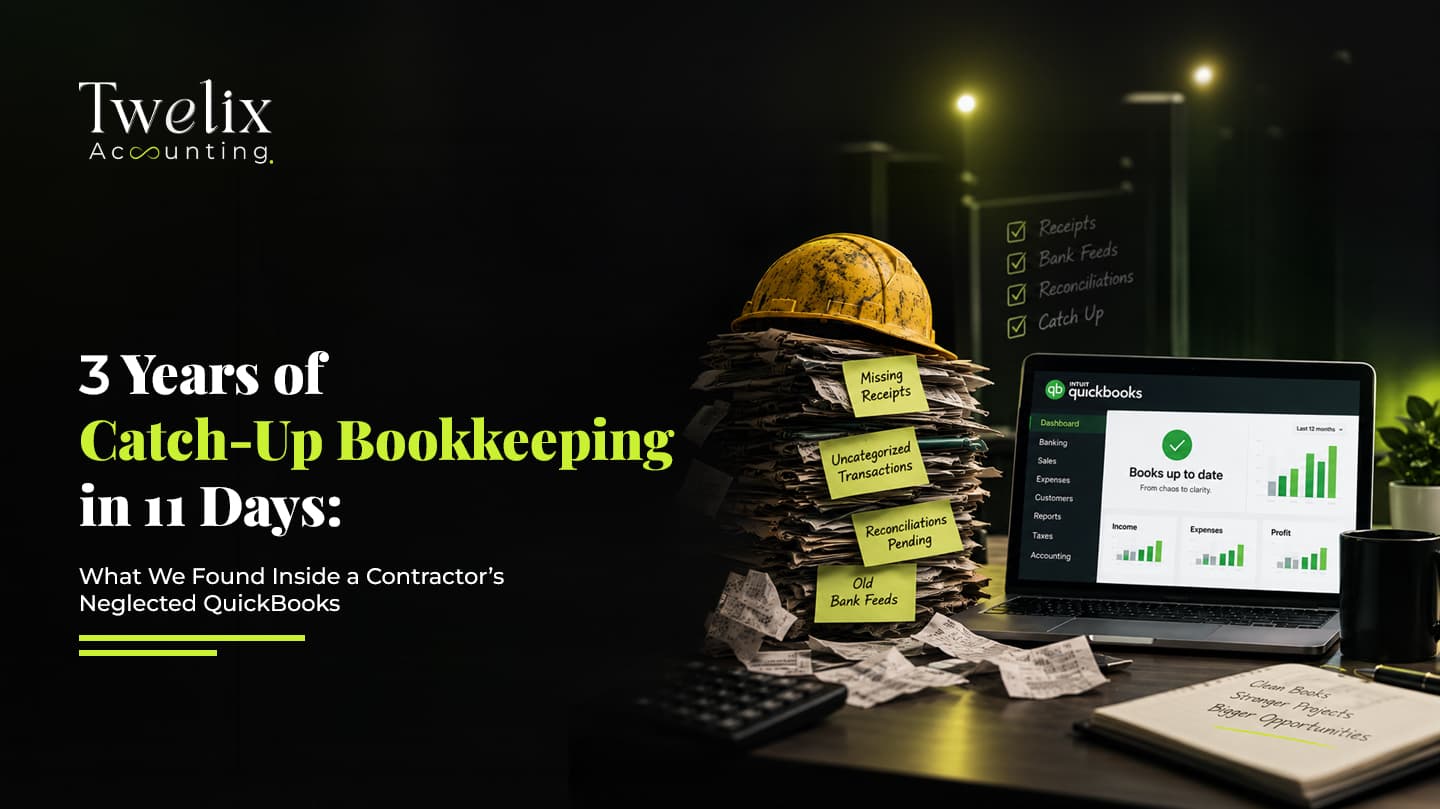
Most engagements run 3 to 15 business days, depending on how many months and accounts are involved. A longer piece on this site breaks down what moves a job toward the short end or the long end of that range. One contractor had three years of catch-up bookkeeping done in 11 days once the scope was set correctly on day one. That's the best case for what a properly scoped review can do.
See what a books review covers.
The Real Problem Isn't Messy Transactions, It's Months Nobody Reconciled
#The real problem isn't messy transactions. It's months nobody reconciled. A single miscoded expense costs you nothing. Twelve unreconciled months cost you a tax season spent explaining numbers you can't fully trust, and a CPA bill padded with cleanup work you never scheduled.
Twelix runs a Cleanup & Catch-Up service built around exactly this. One review shows you where the real gaps are. A flat project fee replaces an open-ended hourly bill. A handoff into monthly bookkeeping follows once your books are current and correct.
A books review takes about 30 minutes and comes with no commitment after it. If you counted four or more yeses above, it's worth the half hour. The timeline from there runs 3 to 15 business days.
Why Owners Bring This to Twelix
#Finding 13 signs is one thing. Fixing them without creating new ones is another. A reconciliation error caught halfway through a cleanup, or a login handed to the wrong person, turns a books problem into a bigger problem.
Twelix works inside the software you already use, QuickBooks or Xero, with read-only links where the software allows it, role-based permissions, and logged actions. The team is QuickBooks ProAdvisor certified at both Level 1 and Level 2, Sage Intacct certified, and Bill.com certified, and Twelix itself is ISO 27001 certified for information security. That matters most during a cleanup, when old statements, old logins, and a full year of transaction history are all in play at once.
Pricing is flat rate, agreed before work starts, month to month with no long contract. A books review that finds three months of gaps and a review that finds twelve do not get the same invoice treatment elsewhere. Here, the quote reflects the scope, not the hours someone happened to log.
Twelix works with more than 250 clients across 15+ industries, and each one gets a resource assigned to that specific industry rather than a generalist rotating between unrelated businesses. Once a cleanup closes, the monthly package that follows includes a P&L, balance sheet, cash flow statement, and a short summary of insights, delivered by the 10th of the following month, every month.
Frequently asked questions
What are the signs of bad bookkeeping?
Bad bookkeeping shows up as a pattern of unreconciled accounts, growing piles of uncategorized transactions, and reports that don't match reality. The clearest signs include a software bank balance that doesn't match the real statement, prior periods that were never properly reconciled, invoices in accounts receivable that customers already paid, and a P&L that swings in ways the business didn't actually feel. One of these on its own is a normal, fixable mistake. Several together, especially unreconciled prior periods, usually mean the problem has been compounding for months.
How do I know if my books are wrong?
The fastest check is comparing your software's bank balance to your actual bank statement for the same date. If they match, check your uncategorized transactions bucket next: a small amount is normal, a growing pile is not. Beyond that, check whether every month this year has actually been reconciled, not just reviewed for a balance that looks close. The Cleanup Risk Score earlier in this piece turns these checks into one number.
What are the most common bookkeeping mistakes?
The most common mistakes are unreconciled bank and credit card accounts, uncategorized transactions that pile up instead of getting coded, and personal spending mixed into business accounts. Close behind are duplicate transactions from bank feeds, invoices marked open after a customer already paid, and sales tax or payroll liabilities that don't match what was filed. Most of these are individually easy to fix. The real damage happens when several compound together across unreconciled prior periods, since each one carries its errors into the next.
How long does a books cleanup take?
Most catch-up or cleanup engagements run 3 to 15 business days once a provider has reviewed the file and scoped the work. The exact range depends on how many months and accounts are involved, and whether prior-year numbers need correcting. A free books review comes first and sets the real timeline.

CA Jaimin M.
Founder & CEO, Twelix Accounting
Published
Jaimin M. is the founder and CEO of Twelix Accounting, where he leads strategy and overall direction. A Chartered Accountant with more than eight years in U.S. accounting, he shapes how Twelix delivers outsourced bookkeeping and accounting services to small businesses. When he is not running the company, he is deep in a game, insisting it is helping his strategy skills.
Connect on LinkedIn