Key takeaways
- Catch-up bookkeeping starts at the last clean month and reconciles every account forward from there, in order.
- In this composite contractor file, deposits added as new income instead of matched to open invoices overstated revenue by $328,000 over three years.
- A personal card paid by the business hid $61,400 of owner distributions and put $48,500 of personal spending on two tax returns.
- Reconciling 36 months of statements also surfaced $32,400 of unclaimed deductions and a $12,650 subcontractor bill paid twice.
- Most cleanups take 3 to 15 business days; this three-year file took eleven.
In this article
- The file we opened
- What catch-up bookkeeping actually includes
- Finding 1: Income counted twice
- Finding 2: 31 months never reconciled
- Finding 3: Owner draws booked as expenses
- Finding 4: Deductions nobody claimed
- Finding 5: The overpayment we recovered
- Before and after: the balance sheet
- How long a cleanup takes: the 3 to 15 day rule
- Your Cleanup Risk Score
- The file was not hopeless. It was ignored.
- Frequently asked questions
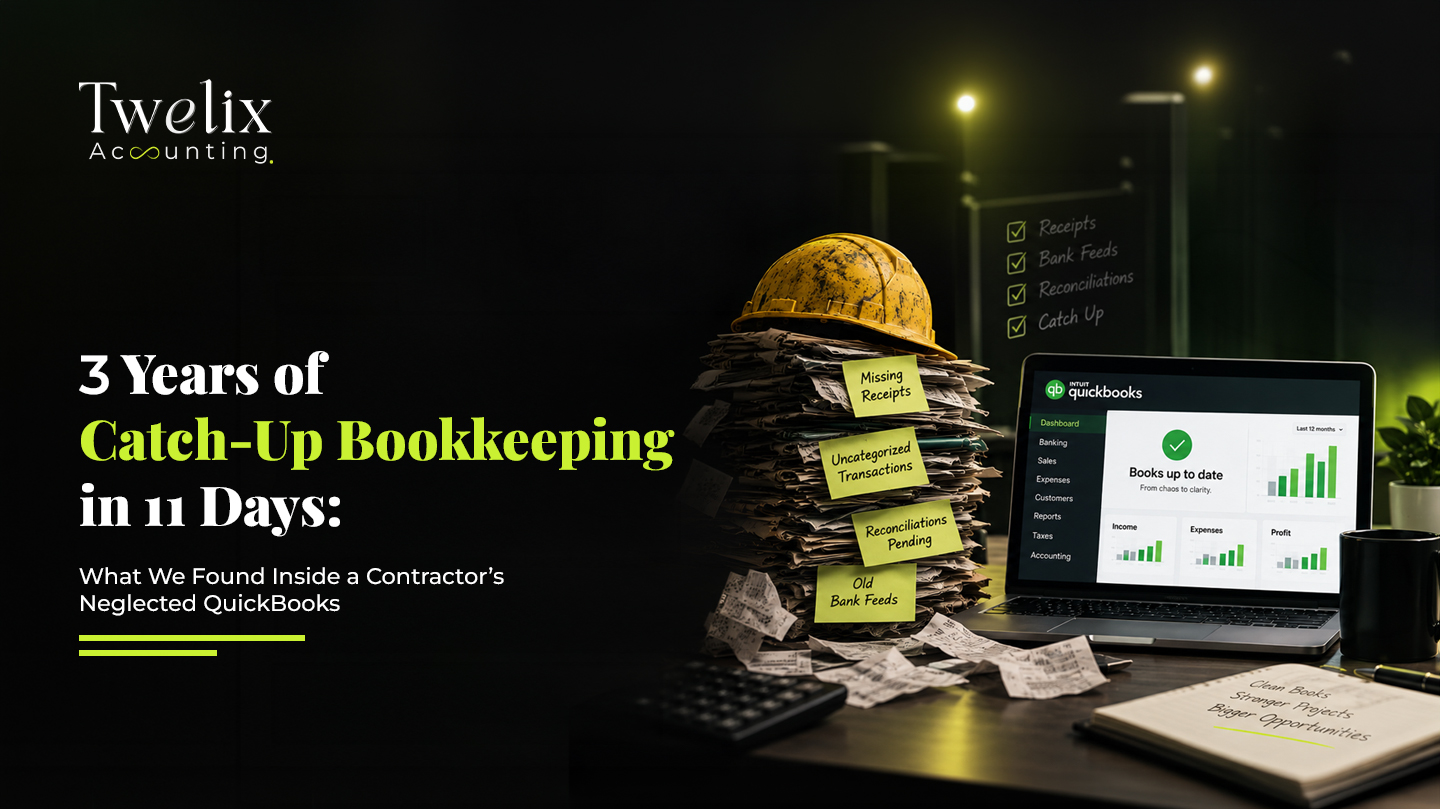
The QuickBooks invite came through on a Tuesday afternoon in August. The owner runs a residential remodeling and additions business, eleven people on a good week, and he had been meaning to send it for about a year.
Here is what the file showed before we touched anything. Last reconciliation on the operating account: August 2023. Bank feed backlog: 2,184 transactions sitting in For Review. Three tax years, 2023 through 2025, filed off numbers nobody had checked. A business credit card nobody had ever reconciled, and a personal card that did most of the buying.
None of that is a character flaw. By year three, most contractor files look like this, because the one person who could fix it is on a job site. It is a time problem, and it is fixable.
Quick answer
To catch up bookkeeping that is months or years behind, work back to the last clean month and reconcile every account forward from there. Fix duplicated and misclassified transactions, separate owner draws from expenses, rebuild the balance sheet, and hand your CPA a file with a list of what changed. Done properly, it takes 3 to 15 business days, depending on months behind, transaction volume, and how many accounts were never reconciled.
The file we opened
#A cleanup starts with an inventory, not a fix. Before anyone categorizes a transaction, we run the balance sheet, the profit and loss, the reconciliation history, and the audit log, and we write down what is actually in the file. This one took most of day one.
| Item | What we found |
|---|---|
| Period covered | September 2023 to August 2026, 36 months |
| Accounts in the file | Operating checking, business savings, one business credit card, one truck loan |
| Last reconciled | Checking: August 2023. Credit card: never. Savings: not connected to the bank feed |
| Uncategorized | 2,184 transactions in For Review, plus 611 posted to Uncategorized Expense or Ask My Accountant |
| Apps connected | Bank feeds for checking and the card, a payroll app, a card-payment processor for customer deposits |
| Tax returns filed on this file | 2023, 2024, and 2025, cash basis, by an outside CPA |
| Entity and software | S corporation, QuickBooks Online Plus |
The file in this post is a composite. It is one storyline assembled from contractor cleanups we have completed, with figures rounded and details changed so no client is identifiable. The five findings are the ones we see most often in contractor files, and the order we found them in is the order you would too.
What catch-up bookkeeping actually includes
#Catch-up bookkeeping brings a file from its last clean month to today, and cleanup fixes what was recorded wrong along the way. A three-year-old contractor file always needs both, because nobody falls three years behind while recording everything correctly. The steps do not change: reconcile every account back to the last clean month, fix what the reconciliations expose, rebuild the balance sheet, and hand back a file with a change report the CPA can use.
We will not walk the process step by step here. Our bookkeeping cleanup and catch-up page has the timeline estimator by months behind, and the first-30-days section of our outsourced bookkeeping guide covers the handoff into a monthly close. This post is about what the process turned up.
Finding 1: Income counted twice
#What we saw. Revenue on the 2025 profit and loss read $1,742,000. Customer deposits into the bank that year came to $1,598,000. The $144,000 difference was invoices that had been paid and never closed.
Why it happens to contractors. Progress billing. The owner invoiced each draw on a job from QuickBooks. When the check cleared and the deposit arrived through the bank feed, he added it as new income, because that is the obvious thing to do when the feed asks what a deposit is. The invoice stayed open, so the file held the same dollars twice.
What it did to the numbers. The file overstated revenue across the 36 months by $328,000: $318,300 through open invoices and $9,700 through deposits entered twice. Accounts receivable read $367,600 when the real figure was under $50,000, and the owner priced his 2026 bids off a 24 percent gross margin that was really 17. The returns caught less of this than you would expect, because the CPA filed on a cash basis, where an unpaid invoice does not exist. The accrual reports the owner read every month carried all of it.
What we did. Matched every deposit to its invoice, month by month, and reversed the duplicate income. One rule going forward: deposits get matched, never added.
Finding 2: 31 months never reconciled
#What we saw. The operating account was last reconciled in August 2023 by an office manager who left that October. Nobody reconciled 31 of the 36 months since. The other five had been forced to agree in a single weekend in early 2025, with $4,180 of reconciliation discrepancy entries. Nobody had reconciled the credit card once in three years.
Why it happens to contractors. The person who reconciled leaves, the owner inherits a screen he has never used, and the bank balance looks fine. QuickBooks runs a profit and loss on unreconciled months without a word of warning. Busy season arrives, and August 2023 quietly becomes the last clean month.
What it did to the numbers. Cash on the books sat $9,700 above the bank, sixty-one old checks had never cleared, and the double counting in Finding 1 stayed invisible for three years, because reconciling is exactly where a deposit matched to nothing gets noticed.
What we did. Thirty-six checking statements and thirty-six card statements, reconciled in order from September 2023 forward, with the five forced months undone and redone. The mechanics are in our walkthrough of reconciling in QuickBooks Online, including the Four-Cause Difference Test, so we will not repeat them here.
Finding 3: Owner draws booked as expenses
#What we saw. The owner's personal Visa did the buying at the big-box store, the lumber yard, and the pump on job sites, and it also paid for groceries, a family trip, and the note on a personal truck. The business checking paid the card in full every month, and he coded every payment to Materials because that is what most of the card was. Over 36 months, $261,000 went to that card: $199,600 of it job costs, $61,400 personal.
Why it happens to contractors. The personal card is in the wallet at 7 a.m. and the business card is in the office. Nobody decides to mix them. It happens on the first job site of the week and never gets undone.
What it did to the numbers. Profit and owner distributions were each understated by $61,400 across three years, which matters on an S corporation because distributions affect basis. The 2024 and 2025 returns also claimed $48,500 of personal spending as business expense, which is not something the CPA can leave alone once he knows.
What we did. Pulled all 36 card statements, split every payment into job costs and a distribution, and closed the personal card out of the business. Going forward, the business pays business cards only, and a personal purchase for a job gets reimbursed against a receipt once a month.
Finding 4: Deductions nobody claimed
#What we saw. $47,900 across 2024 and 2025 sitting in Uncategorized Expense and Ask My Accountant. The CPA's workpapers excluded both accounts from the returns as unsupported, with a note asking for detail. A phone call answered the note, and the return did not change.
Why it happens to contractors. Dump fees, permit fees, tools from odd vendors, and fuel from stations that show up on the feed as a terminal number. Nothing looks like a category, so nothing gets one.
What it did to the numbers. $32,400 of real, deductible business costs never claimed across two years. The rest was $8,100 of personal spending, which joined the Finding 3 total, and $7,400 of duplicates. On the amended returns, Findings 3 and 4 pull in opposite directions: $48,500 of personal spending comes out and $32,400 of real costs goes in. The owner will owe a little on the difference, and he will sign returns that are right, which he could not say before.
What we did. Categorized every line with the owner in two 45-minute calls, attached receipts where they existed, and wrote vendor rules so the feed does it next time.
Finding 5: The overpayment we recovered
#What we saw. While rebuilding accounts payable from subcontractor invoices, one plumbing sub's account showed a payment that matched no bill. In March 2025 the owner paid the sub's draw by ACH from the emailed invoice. In April, after a software change on the sub's side, their office re-sent the same invoice marked unpaid, and he paid it again by check. $12,650, paid twice and expensed twice.
Why it happens to contractors. Sub draws arrive by email, by text, and on paper, and the one in front of you is the one that gets paid. Without a payables list, a duplicate looks like any other expense.
What it did to the numbers. Subcontractor expense for 2025 overstated by $12,650, and cash that had left the business and never come back.
What we did. Sent the sub both payment records. They confirmed within a day and applied a $12,650 credit against a current job's draw at the end of August. One line, found on day six, and the number the owner quotes when he tells the story.
Before and after: the balance sheet
#Six lines from the balance sheet as of July 31, 2026, as the file showed them on day one and as they stood on day eleven. This is the artifact the whole engagement produces.
| Line item | As found | After cleanup | Change |
|---|---|---|---|
| Cash, operating account | $148,300 | $138,600 | -$9,700 |
| Accounts receivable | $367,600 | $49,300 | -$318,300 |
| Accounts payable | $18,100 | $37,900 | +$19,800 |
| Owner distributions, 2026 year to date | $11,000 | $23,900 | +$12,900 |
| Retained earnings | $498,600 | $256,250 | -$242,350 |
| Net income, January to July 2026 | $158,400 | $78,500 | -$79,900 |
What the CPA could not have known from the "as found" column is which number was wrong: the $367,600 the customers supposedly owed, or the revenue that figure implied. A CPA works from the file. If the file says customers owe you $367,600, the questions start there, and they take a phone call to answer. Three years of returns rested on that phone call. Nothing in the "as found" column was a lie, and nothing in it was true.
How long a cleanup takes: the 3 to 15 day rule
#Eleven business days from the invite to the handoff. Here is where they went.
| Days | What happened |
|---|---|
| Day 1 | Read-only access, a backup, and the inventory above. Agreed with the owner that August 2023 was the last clean month |
| Days 2 to 3 | Gathered 36 months of bank and card statements. Cleared the 2,184 transactions in For Review, with the owner naming jobs on a shared list |
| Days 4 to 6 | Reconciled checking and the card month by month from September 2023. The double counting surfaced on day four; the $12,650 duplicate surfaced on day six while rebuilding payables |
| Days 7 to 8 | Split the personal card statements (Finding 3) and worked the uncategorized pile with the owner on two calls (Finding 4) |
| Day 9 | Rebuilt the balance sheet: loan balance tied to the lender statement, equity recast, prior-year adjustments dated to the right year |
| Day 10 | Review with the owner. CPA package: adjusted trial balance, change report by year, notes for the amended 2024 and 2025 returns |
| Day 11 | Handoff. Closing date set with a password, vendor rules live in the feed, first monthly close scheduled |
Our working rule is 3 to 15 business days. Three covers a file under six months behind with one bank account and no payroll. Fifteen covers two to three years behind with several accounts and payroll. This file sat at eleven: three years, two active accounts, a payroll app, and no inventory to count. The estimator on our cleanup and catch-up page gives the range by months behind, and the table above is what those days actually contain.
Your Cleanup Risk Score
#Five yes or no questions. Count the yeses.
- Is the last reconciliation on your main bank account older than three months?
- Has a personal card been used for business purchases in the past year?
- Does the owner get paid through anything coded as an expense, including card statements paid by the business?
- Are there more than 50 transactions sitting in For Review, Uncategorized Expense, or Ask My Accountant?
- Did your CPA ask for adjustments or missing detail on last year's return?
- 0 to 1. Current enough to keep. Reconcile monthly and re-run this list at year end.
- 2 to 3. A cleanup is ahead, and it is a small one if you do it now: days, not weeks, and your next return goes out on checked numbers.
- 4 to 5. This is the file in this post. Stop adding to it, get a diagnostic, and tell your CPA before the next return goes out. Every month you wait adds a month of statements.
The file was not hopeless. It was ignored.
#Nothing in this file was unusual, and nothing in it was beyond repair. Income counted twice, months never reconciled, a personal card doing business work, a pile of uncategorized costs, and a sub paid twice: any one of them is a Tuesday in cleanup work. Together, they meant the owner ran three years of decisions and three tax returns on numbers nobody had checked.
What he has now: a file his CPA can work from, with a change report by year and notes for two amended returns. A $12,650 credit he did not know he was owed. Bids priced on a 17 percent margin instead of a 24 percent one that never existed. And a monthly close on a fixed date, so August 2026 is the last month anyone has to catch up. If your file looks like the inventory at the top of this post, that is the work we do, inside the QuickBooks file you already have.
Frequently asked questions
How do I clean up messy QuickBooks?
Start from the last month that was properly reconciled, not from today. Gather every bank and card statement from that month forward and reconcile each account month by month, in order. Reconciling is what exposes the real problems: deposits added instead of matched, duplicate entries, and payments that match no bill. Fix those as they surface, move personal spending out of expenses and into owner draws, and work through the uncategorized pile last, with receipts where you have them. Finish by rebuilding the balance sheet, setting a closing date, and giving your CPA a report of what changed by year. A file more than a year behind, or with several accounts, is a multi-day job that goes faster with someone who has done it before.
How long does a QuickBooks cleanup take?
Most cleanups take 3 to 15 business days. The low end covers a file under six months behind with one bank account and no payroll. The high end covers two to three years behind with several accounts and payroll. Three things drive the count: how many months must be reconciled, how many transactions sit uncategorized, and how many accounts were never reconciled at all. The file in this post took eleven business days for three years, two active accounts, and a payroll app. Ask any provider for a day count after a diagnostic, not before. Until someone has read the reconciliation history and counted the backlog, an estimate is a guess. Twelix quotes a flat rate and a timeline within 24 hours on business days after a free review.
What does a bookkeeping cleanup include?
A proper cleanup reconciles every bank, card, and loan account back to the last clean month, fixes transactions that were duplicated or posted to the wrong account, separates owner draws from business expenses, categorizes everything left in Uncategorized Expense or Ask My Accountant, rebuilds the balance sheet so cash, receivables, payables, loans, and equity tie to real statements, and sets a closing date. It ends with a written change report your CPA can use, including prior-year adjustments and whether an amended return is worth filing. It does not usually include preparing the return itself, and it is separate from monthly bookkeeping, which starts once the cleanup ends. If a provider's scope leaves out the balance sheet or the change report, ask why.
Should I start a new QuickBooks file instead of cleaning the old one?
Usually no. A fresh file looks tidy, but it does not fix the years already filed, and its opening balances have to come from somewhere. If the old balance sheet is wrong, the new file starts wrong too, with less evidence of why. Starting over makes sense in narrow cases: the file belongs to a different entity, it is corrupted, or the chart of accounts is so tangled that rebuilding beats repairing. For a file that is simply behind, cleaning the existing one is faster, keeps your history and vendor rules, and gives your CPA one continuous record. We repaired the three-year file in this post in place, in eleven business days, with no migration.
Will a cleanup change my already filed tax returns?
A cleanup changes your books, not your filed returns. What it produces is a clear record of what was wrong in each prior year and by how much. Your CPA then decides whether an amended return is worth filing, and small differences often go into the current year instead. In the file in this post, two findings pointed in opposite directions: $48,500 of personal spending had been claimed as business expense, and $32,400 of real costs had never been claimed. The CPA is amending 2024 and 2025 because the personal spending has to come out. A good cleanup dates every adjustment to the year it belongs in and gives your CPA a change report by year, so that decision takes an hour, not a reconstruction.

CA Jaimin M.
Founder & CEO, Twelix Accounting
Published
Jaimin M. is the founder and CEO of Twelix Accounting, where he leads strategy and overall direction. A Chartered Accountant with more than eight years in U.S. accounting, he shapes how Twelix delivers outsourced bookkeeping and accounting services to small businesses. When he is not running the company, he is deep in a game, insisting it is helping his strategy skills.
Connect on LinkedIn