Key takeaways
- Virtual bookkeeping services win for most US small businesses on cost, coverage during absences, and turnover risk.
- An in-house hire wins when you need same-day action on payments and approvals, or volume keeps one person busy all month.
- Transaction volume decides this more reliably than headcount, because bookkeeping hours track transactions rather than employees.
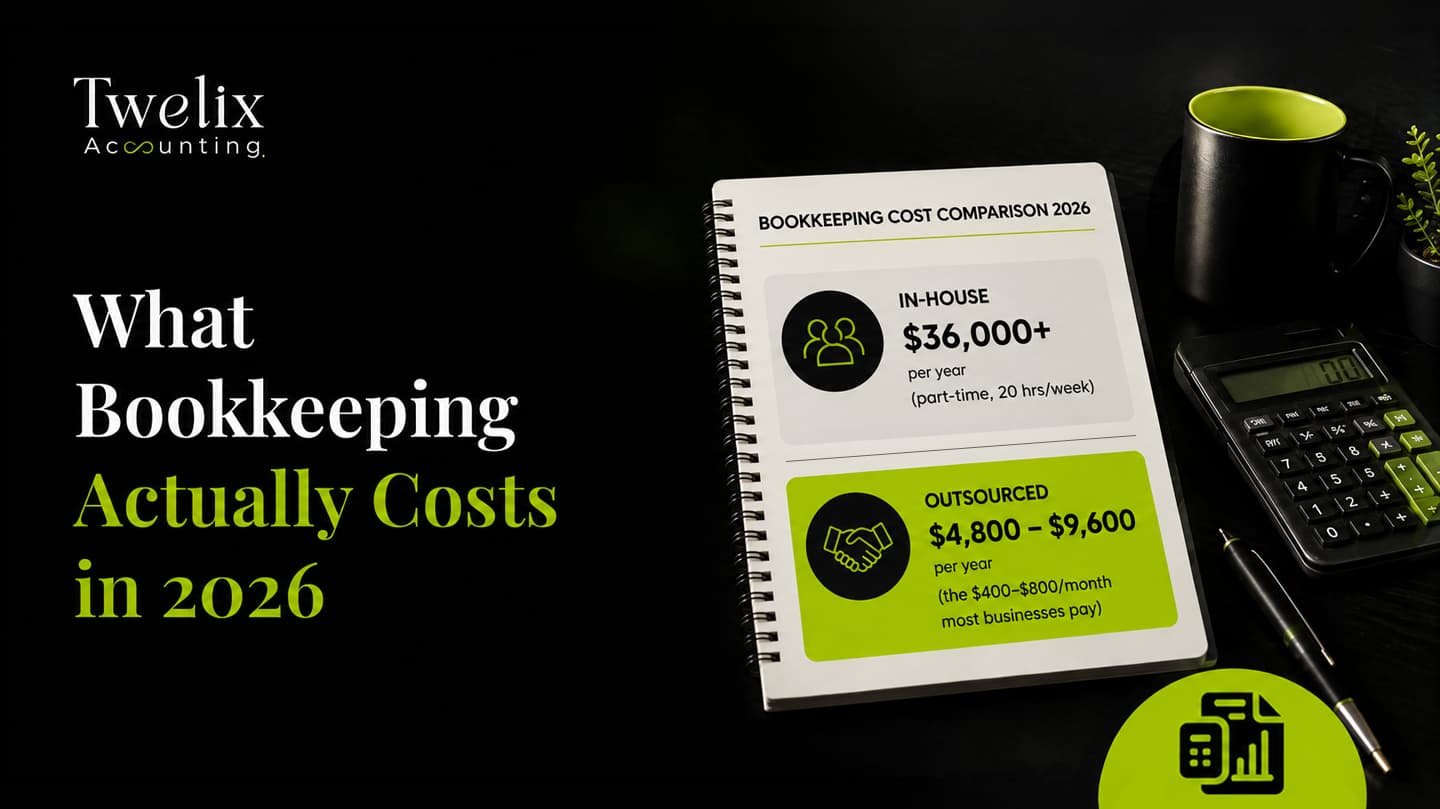
- The 2024 median US bookkeeping clerk wage of $49,210 becomes roughly $62,000 to $70,000 a year once employer costs are added.
- You keep the administrator account, and a provider works in your file through permissions without any ability to move money.
In this article
Search for a comparison of virtual bookkeeping services and an in-house hire, and almost every result is published by a company that sells one of them. The conclusion is written before the comparison starts. One page currently ranking states flatly that an in-house hire has limited skills. Another leads with a headline explaining why virtual is better. Those are sales pages wearing a comparison headline.
This is not that. In-house vs outsourced bookkeeping is a real decision with real trade-offs, and in-house genuinely wins in some situations.
Below is a side-by-side across the six things that actually decide it: cost, control, coverage, security, turnover risk, and software access. Then a table to place your own business on the scale, by size and transaction volume.
We keep books for US small businesses, so we have a side in this. We have also told business owners to keep the function in-house when that was the right answer, and this article says where those lines fall.
The Short Answer
#Virtual bookkeeping services win for most US small businesses on three things: cost, coverage during absences, and turnover risk. An in-house hire wins when you need same-day action on payments and approvals, or when transaction volume is high enough to keep one person genuinely busy all month.
Transaction volume decides this far more reliably than headcount does. A 40-person firm with simple books often needs less bookkeeping time than a 6-person e-commerce business processing thousands of orders.
What Virtual Bookkeeping Actually Means
#Three terms get used interchangeably, and they are not the same thing.
Virtual bookkeeping means a remote team keeps your books inside the accounting software you already use. You get an assigned point of contact, a monthly close, and financial statements on a schedule. People do the work, supported by software.
An in-house hire is an employee on your payroll. They sit inside your business, work your hours, and can be pulled into other tasks. You carry the salary, the benefits, the software seats, and the desk.
Online bookkeeping services is the broader category that sits around both. Some providers in it are genuinely people-led. Others are software-first platforms where categorization is largely automated and human review is thin. The label tells you very little, so ask any provider a direct question instead: who actually reviews my reconciliations before the reports go out?
The Six Things That Actually Decide This
#Step 1: Cost
An in-house hire costs considerably more than the salary line. The median US wage for bookkeeping and accounting clerks was $49,210 in 2024, according to the Bureau of Labor Statistics. Then add employer payroll taxes, benefits, paid leave, software seats, and a desk. The common rule of thumb puts the true cost at 1.25 to 1.4 times salary. That places most in-house roles between roughly $62,000 and $70,000 a year.
Virtual bookkeeping services are normally sold as monthly bookkeeping services on a flat or tiered fee. Typical US pricing starts at a few hundred dollars a month for a simple service business. Higher volume with payroll and accounts payable support runs into the low thousands. Either way, you are paying for a defined scope of work rather than for a seat.
The gap is real, but it is not the whole story. A flat fee buys scope. A salary buys availability. If you genuinely need someone who can drop everything at two in the afternoon, you are buying availability, and availability costs more. Our guide to outsourced bookkeeping pricing models breaks down hourly, flat monthly, and volume-based billing in full.
In Florida the in-house side of that comparison has moved. The state's minimum wage reached $15 an hour on September 30, 2026, and what that does to the cost of an in-house employee is worked out in full in its own post.
Salary figure: US Bureau of Labor Statistics, median annual wage for bookkeeping, accounting, and auditing clerks, May 2024. Loaded-cost multiplier is a widely used industry rule of thumb, not a BLS figure.
Step 2: Control
Control is the objection people raise out loud. The real fear underneath it is a black box: someone else holds your numbers, and you cannot see what they are doing in there.
The answer is that you keep the administrator account and the data never leaves your software. Your provider works inside your file through read-only access, a bookkeeping permission set that lets them see and categorize transactions without any ability to move money.
What that buys you is visibility rather than trust. QuickBooks and Xero both keep an audit trail. Every change is recorded against the user who made it, so you can log in at any hour and see exactly what has been touched and by whom.
That is more oversight than most owners have over an employee down the hall. Nobody runs an audit trail report on the person at the next desk.
Step 3: Coverage During Holidays and Sickness
This is the objection that never appears in a brochure, and it decides more of these calls than cost does.
One in-house person is one point of failure. When they take two weeks off in July, the books wait. When they are out sick through month-end, the close slips. When they resign, the function stops completely until you have hired and trained a replacement, which realistically takes months. There is no backup unless you employ a second person, and almost no small business does.
A team model does not have that failure mode. Someone else picks up the file, because the process is documented and the work does not live in one person's head. Your month-end close stops depending on one individual's health, holiday plans, or notice period.
That is the honest difference. Not that virtual is better on an ordinary Tuesday, but that it holds up on the Tuesday your only in-house hire calls in sick during close week.
 View full size
Step 4: Security
Handing financial data to an outside company deserves scrutiny. Here is what to actually check, in the order it matters.
Access. A provider should never need your bank login. Connections run through your accounting software's own permission system and through read-only bank feeds. Ask which specific permissions they will hold, and ask directly whether they require credentials for anything at all. Our pillar guide covers how read-only access works in detail, including the exact questions to put to any provider.
Encryption and storage. Data should be encrypted in transit and at rest, and held in a controlled environment rather than on somebody's laptop. Ask where your data physically lives.
Independent certification. An audit such as ISO 27001 or SOC 2 means a third party has verified the controls, rather than the provider simply describing them. None of this is legally required in order to keep books, which is precisely why it is worth asking. Twelix is ISO 27001 certified, and we expect you to ask us for the certificate rather than take our word for it.
What happens when someone leaves. This is the question most people forget, and it cuts both ways. With an in-house hire, offboarding is your job, and access very often lingers longer than it should. With a provider, revoking access is a contractual obligation and a documented process. Ask them to describe that process before you sign, and ask what happens to your data if the relationship ends.
 View full size
Step 5: Turnover Risk
Every in-house departure costs you twice. You pay to recruit and train a replacement, and you pay again in the gap where nobody is doing the work.
The books rarely survive that gap cleanly. Transactions pile up, reconciliations slip, and the new hire spends their first month cleaning up rather than producing anything. If the departure lands near year-end, the cost carries into your tax preparation as well.
With a provider, turnover is theirs to absorb. Staff changes still happen, but they happen inside their company and continuity is contractual. The process, the documentation, and your file history all stay where they are. You are buying a service that continues rather than a person who might leave.
Step 6: Software Access
A good provider works inside the stack you already have. If your business runs on QuickBooks Online or Xero, that is where the work should happen.
Be careful here, because some providers require you to move onto their own platform. That means ripping out a system your team already knows, usually mid-year, and moving your historical data into an environment you do not control. A no-forced-migration policy should be stated up front, not discovered after you sign. Ask the question directly: will you work inside my existing file, or do I need to move? The answer tells you whether you are buying a service or joining a platform.
We work in QuickBooks and Xero files exactly as we find them. No migration, no new login for your team to learn, and your historical data stays where it has always been.
Which One Fits Your Business?
#Headcount alone does not decide this. Transaction volume does most of the work, because bookkeeping hours track transactions rather than employees. Find your row and your column.
| Business size | Low volume (under ~200/mo) | Medium volume (~200 to 750/mo) | High volume (750+/mo) |
|---|---|---|---|
| Solo or micro (1 to 4 people) | Virtual, entry tier. Nowhere near enough work to justify a salaried seat. | Virtual. The volume needs a professional, but not a full-time one. | Virtual, higher tier. Real volume, but a full salary is still hard to justify. |
| Small team (5 to 20 people) | Virtual. Payroll adds complexity rather than hours, and providers handle it routinely. | Virtual. The most common fit, and where flat monthly pricing works best. | Virtual, or virtual plus a part-time in-house coordinator for same-day approvals. |
| Established (20 to 50+ people) | Virtual. Headcount is not what drives bookkeeping hours. | Either. Decide on approval speed, not cost. If payments must clear same day, lean in-house. | In-house or hybrid. Enough sustained work to keep someone genuinely busy, and same-day control starts to matter. |
The pattern across that table is worth naming. Virtual fits almost everything below sustained high volume, because below that line you cannot keep a full-time person genuinely occupied with bookkeeping alone. What pushes a business toward in-house is rarely size on its own. It is the combination of high transaction volume and a genuine need for same-day action.
If you land in a cell marked "Either," use the same-day test. In the last three months, how many times did you actually need something done within hours rather than within days? If the honest answer is under three, the case for a salaried seat is weaker than it feels. If it is weekly, you are buying availability, and that is worth paying for.
How Switching Actually Works
#The commitment question comes up early, so here is the direct answer. A month-to-month bookkeeping engagement means no annual lock-in and no cancellation penalty. You stay because the reports arrive on time and the numbers are right, not because a contract says you have to.
That matters more than it sounds. An annual contract removes the provider's incentive to perform after month two. A monthly one keeps it in place for the whole relationship.
Switching also does not touch your software. Your file stays where it is, your historical data stays intact, and access is granted through permissions rather than a migration. Most of the work in a switch is catching up anything left unreconciled, not moving systems.
The Honest Answer
#Virtual is not always better. It is better for most small businesses, for reasons that have more to do with coverage and turnover than with price.
Find your row in the table above, then apply the same-day test. That one question settles it more reliably than any comparison article can.
If the table points you toward virtual, that is the work we do. Flat monthly pricing, a named point of contact, and a close that lands on schedule inside the software you already run.
Frequently asked questions
Is virtual bookkeeping better than in-house?
Neither is better in every case, and any article claiming otherwise is selling something. Virtual bookkeeping services win on three things that matter to most small businesses: total cost, coverage when someone is sick or on holiday, and turnover risk. An in-house hire wins on two: same-day action when payments or approvals cannot wait, and the ability to pull that person into work outside bookkeeping. The deciding factor is usually transaction volume, not company size. Below roughly 750 transactions a month, most businesses cannot keep a full-time person genuinely occupied with bookkeeping alone. That makes the salaried seat hard to justify. Above that line, and especially where same-day approvals are routine, in-house starts to make real sense.
What is the difference between virtual and outsourced bookkeeping?
In practice, very little. Outsourced bookkeeping is the umbrella term for hiring an outside firm rather than employing someone directly. Virtual bookkeeping describes the same arrangement with an emphasis on remote, cloud-based delivery inside software you already own. Most providers use the two terms interchangeably, and no industry body defines either one, so the label tells you almost nothing about what you are actually buying. Judge the service instead. Ask four things. Who reviews your reconciliations before reports go out? Do you get a named point of contact or a shared queue? Does the work happen in your existing file or theirs? What is the monthly delivery date? Those answers separate providers far more reliably than the word on the homepage.
How does a virtual bookkeeping service access my accounts?
Through your accounting software's own permission system, never your bank login. You invite the provider as a user in QuickBooks Online or Xero and grant view-and-categorize rights. That lets them see transaction history, categorize entries, reconcile accounts, and generate reports. Bank data flows in separately through read-only feeds pulled by the software's own aggregator, so the provider never holds your banking credentials. They cannot move money, authorize a payment, or change your banking details. You keep the administrator account throughout, so you can change or revoke access yourself at any time without asking anyone. Every action inside the file is recorded in the software's audit trail against a username and timestamp, so nothing happens invisibly.
What is virtual bookkeeping?
Virtual bookkeeping is having a remote team keep your books inside the accounting software your business already uses, rather than employing someone on your payroll to do it. The scope usually covers categorizing transactions, reconciling bank and credit card accounts, and delivering monthly financial statements. That means a profit and loss statement, a balance sheet, and a cash flow statement. Work happens off-site on a scheduled monthly cycle rather than in your office in real time. Most engagements begin with a cleanup phase to bring historical records current before the regular monthly rhythm starts. What it typically excludes is tax filing, invoicing your customers, and CFO-level strategy, all of which are usually separate services.
How does virtual bookkeeping work?
After an onboarding period that usually includes cleaning up historical records, the engagement settles into a repeating monthly cycle. Early in the month, the prior month's transactions are categorized and matched against bank activity. Mid-month, open reconciliation items get resolved. This is where you may get a short list of questions only you can answer, such as what a particular transfer was for. Near month-end, accounts are reconciled and statements prepared. Your financial package normally arrives within the first week or two of the following month, so your numbers are 30 to 45 days old at most. Expect to spend one to two hours a month on your side, mostly forwarding receipts and answering categorization questions.

CA Jaimin M.
Founder & CEO, Twelix Accounting
Published · Updated
Jaimin M. is the founder and CEO of Twelix Accounting, where he leads strategy and overall direction. A Chartered Accountant with more than eight years in U.S. accounting, he shapes how Twelix delivers outsourced bookkeeping and accounting services to small businesses. When he is not running the company, he is deep in a game, insisting it is helping his strategy skills.
Connect on LinkedIn