Key takeaways
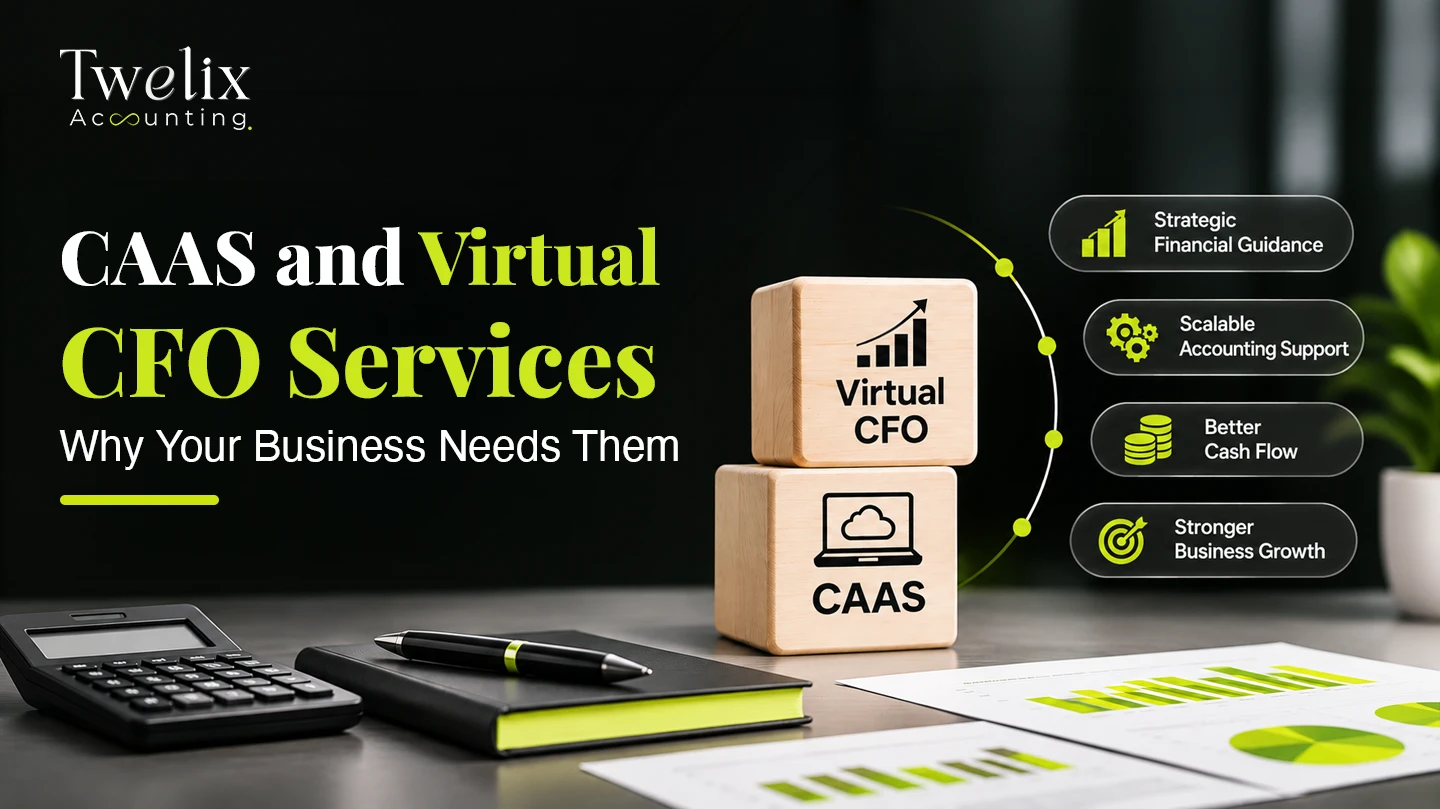
- CAAS (client accounting advisory services) is advisory work layered on top of bookkeeping: forecasting, budgeting, KPI tracking, and strategic guidance.
- Virtual CFO services are the most senior tier of that work, delivering the judgment of a full-time Chief Financial Officer on a fractional basis.
- Three questions show whether a business is ready: its cash runway in months, which part of the business actually makes money, and the revenue at which the next hire pays for itself.
- Most businesses move through the stages in order: clean books first, CAAS once the books are reliable, and virtual CFO-level service once the stakes rise.
In this article
- What Is CAAS (Client Accounting Advisory Services)?
- What Are Virtual CFO Services?
- Why Your Business Needs CAAS and vCFO Services
- The Emerging Trend: Why More Businesses Are Moving to CAAS and vCFO Now
- CAAS vs vCFO vs Traditional Bookkeeping
- What Twelix Delivers: CAAS and vCFO Services Done Right
- The Bottom Line
- Frequently asked questions
Your bookkeeping is current. Your reports arrive on time. You trust the numbers.
But you still make big calls on gut feel. Should you hire now or wait a quarter? Can you afford that new location? Is your pricing actually covering your real costs? Clean books answer what already happened. They do not answer what to do next.
That gap has a name. It is called CAAS, short for client accounting advisory services, and it usually arrives alongside virtual CFO services. Together they turn your financial data into a plan.
Quick answer
CAAS is advisory work layered on top of bookkeeping: forecasting, budgeting, KPI tracking, and strategic guidance. Virtual CFO services deliver the most senior tier of that work: the judgment calls a full-time Chief Financial Officer would make, delivered on a fractional basis. Together, CAAS and vCFO services give a growing business the forecasting and financial strategy a full-time finance team would provide, without the full-time cost. More small and mid-size businesses are adopting both as accounting shifts from a once-a-year compliance task to an ongoing strategic function.
What Is CAAS (Client Accounting Advisory Services)?
#CAAS stands for client accounting advisory services. It is the accounting industry's term for everything that sits above basic bookkeeping and below a full finance department.
Bookkeeping tells you what happened. It produces your P&L, your balance sheet, your reconciled accounts. CAAS tells you what it means and what to do about it. That includes cash flow forecasting, budget-to-actual variance review, KPI tracking, and a recurring strategy conversation where someone walks you through the numbers.
The term itself is relatively new, but the function is not. Accounting firms have offered pieces of this work for decades. What changed is packaging. CAAS bundles forecasting, budgeting, and advisory into a defined, recurring service instead of a one-off project you call in when something breaks. For a provider like Twelix, it is the natural next layer once your books are reliable. For a client, it is the difference between reacting to last month's numbers and planning around next quarter's.
What Are Virtual CFO Services?
#Virtual CFO services, often written vCFO, deliver the work of a Chief Financial Officer without a full-time CFO sitting in your office. You get senior-level financial judgment: cash flow modeling, scenario planning, capital decisions, the conversations a full-time CFO would normally own.
The service is usually scoped as a defined engagement, not an open-ended seat. You get a fixed set of deliverables each month or quarter: an updated forecast, a board-ready report, a scheduled strategy call. What the service does not require is a full-time salary, benefits, or a seat your business may not have enough work to fill five days a week.
Virtual CFO services sit at the top of the CAAS pyramid. Not every business needs them immediately. Most start with advisory support, forecasting and budgeting, then add vCFO-level service once decisions start carrying real financial weight: a raise, a major hire, an acquisition.
Why Your Business Needs CAAS and vCFO Services
#Three questions separate a business that is ready for CAAS and vCFO support from one that still only needs clean books. If you cannot answer any of them right now, that is your answer.
- What is your cash runway, in months, at your current burn rate?
- Which product, service, or client segment actually makes you money, once real delivery costs are counted?
- At what revenue number does your next hire pay for itself?
Bookkeeping gives you the raw numbers behind all three questions. It does not do the math for you, and it does not tell you what to do with the answer. That is exactly the gap CAAS and virtual CFO services close.
There is a cost to skipping this step, and it rarely shows up as one dramatic failure. It shows up as a string of smaller decisions made without the numbers to back them up. A hire brought on too early. A price left too low for a year. A cash crunch nobody saw coming because nobody was watching the forecast.
The Emerging Trend: Why More Businesses Are Moving to CAAS and vCFO Now
#Accounting is shifting from a compliance task to a strategic one, and small businesses are catching up to a change that started inside the accounting industry itself.
For most of the last few decades, accounting firms built their business around compliance work: tax filings, audits, year-end close. That work still matters, but it is increasingly commoditized and automated. Firms are repositioning around advisory services instead. That is where the margin and the client relationship actually sit. Industry surveys have tracked this shift for several years running. Advisory and CAAS revenue is the fastest-growing line item at accounting firms nationally, even as traditional compliance work flattens.
Software accelerated the shift. Cloud accounting platforms made monthly books fast to produce and easy to access in real time. Once the books stopped being the bottleneck, the obvious next step was doing something with them. A business that already has live, accurate numbers in QuickBooks or Xero is one dashboard away from a forecast, not a quarter away from one.
The pandemic years added urgency. Businesses that had never needed to model a cash crunch suddenly needed to, fast. Many owners who had treated forecasting as optional came out of that period treating it as a baseline requirement, the same way they treat insurance.
The practical result for a business owner today: CAAS and virtual CFO services are no longer positioned as something only venture-backed startups or larger companies use. They are increasingly standard for any business past the first stage of simply staying afloat.
CAAS vs vCFO vs Traditional Bookkeeping
#| Your situation | Best fit | Why |
|---|---|---|
| Books are current, no advisory layer on top | Bookkeeping alone | You have the raw data, but nobody is turning it into a plan |
| Books are reliable, you need forecasting, budgeting, and KPI tracking | CAAS | Advisory work layered on top of your existing bookkeeping, scoped to a monthly deliverable |
| Decisions now carry real financial weight: a raise, an acquisition, a major pivot | Virtual CFO services | Senior-level judgment, delivered as a scoped service for the project or the quarter, rather than a full-time seat |
Most businesses move through this table left to right, not straight to the end. Clean books first, CAAS once the books are reliable, vCFO-level service once the stakes rise. Skipping a stage usually means paying for judgment you are not yet positioned to use, or going without guidance you actually need.
What Twelix Delivers: CAAS and vCFO Services Done Right
#We build CAAS and virtual CFO services on the same books we already maintain. It is not a handoff to a separate advisory team learning your business from scratch. The same provider that closes your books each month is the one forecasting from them.
Here is what that looks like month to month. Your base package already includes a P&L, balance sheet, cash flow statement, and a summary of insights, delivered by the 10th. CAAS and vCFO engagements build on that foundation: a rolling cash flow forecast, a budget-to-actual review, and a scheduled call where we walk through what changed and why it matters. Everything is scaled to what your business actually needs this quarter, not a fixed package that does not fit your size.
Flat-rate pricing applies at this level too. No hourly billing, and no surprise invoice after a longer strategy call. Advisory work means deeper access to your numbers and your plans, so the credentials behind it matter more, not less. Twelix is ISO 27001 certified. We hold Intuit QuickBooks ProAdvisor Level 1 and Level 2 certification, and are Sage Intacct and Bill.com certified. We work inside the software you already use. Nothing gets migrated just to run advisory work on top of it.
The Bottom Line
#CAAS and virtual CFO services exist for one reason: clean books answer what already happened, and growing businesses need answers about what happens next. That gap does not close itself, and it rarely announces itself with a single clear signal. It shows up as a string of decisions made without the forecast to support them.
The trend toward advisory accounting is not a temporary shift. It is where the accounting industry, and the businesses it serves, are both headed. The question is not whether your business will eventually need this kind of support. It is whether you build it in now, on your own schedule, or add it later under pressure.
Frequently asked questions
What is CAAS in accounting?
CAAS stands for client accounting advisory services. It is the accounting industry's term for work that sits above basic bookkeeping and below a full in-house finance department. Where bookkeeping produces your financial statements, CAAS uses those statements to build forecasts, track budgets and KPIs, and guide real business decisions. It is typically delivered as a recurring monthly or quarterly service, layered on top of the bookkeeping a provider already maintains, rather than a one-off project. Most businesses adopt CAAS once their books are reliable enough to plan from.
What are virtual CFO services?
Virtual CFO services deliver the work of a Chief Financial Officer on a part-time or fractional basis instead of through a full-time hire. That includes cash flow modeling, scenario planning, and the strategic financial judgment a full-time CFO would normally provide. The service is usually scoped to a defined set of monthly or quarterly deliverables rather than a full-time seat. It gives a growing business access to senior financial judgment without the cost of a full-time executive.
Why does my business need CAAS and vCFO services?
The clearest signal is not a revenue threshold. It is whether you can answer three questions without waiting on someone else. Your cash runway in months. Which part of your business actually makes money, once real costs are counted. The revenue point where your next hire pays for itself. If your current bookkeeping cannot answer those for you, that is the gap CAAS and virtual CFO services are built to close. Skipping that support rarely causes one obvious failure. It shows up as a series of smaller decisions made without the numbers behind them.
Why are CAAS and vCFO services an emerging trend right now?
Accounting firms have been shifting their business away from compliance work, like tax filings and audits, and toward advisory services, because that work is less commoditized and builds a stronger client relationship. Cloud accounting software accelerated this by making monthly books fast to produce, which freed up time to act on them instead of just producing them. The result is that CAAS and vCFO services, once associated mainly with larger or venture-backed companies, are becoming standard for small and mid-size businesses as well.
How is CAAS different from virtual CFO services?
CAAS is the broader category: forecasting, budgeting, KPI tracking, and general advisory work layered on top of bookkeeping. Virtual CFO services sit at the top of that category, the most senior and strategic tier, covering work like capital planning, financing decisions, and board-level reporting. Most businesses start with CAAS-level advisory support. They add virtual CFO services once decisions start carrying heavier financial stakes, such as a fundraise, a major hire, or an acquisition.

CA Jaimin M.
Founder & CEO, Twelix Accounting
Published
Jaimin M. is the founder and CEO of Twelix Accounting, where he leads strategy and overall direction. A Chartered Accountant with more than eight years in U.S. accounting, he shapes how Twelix delivers outsourced bookkeeping and accounting services to small businesses. When he is not running the company, he is deep in a game, insisting it is helping his strategy skills.
Connect on LinkedIn