Key takeaways
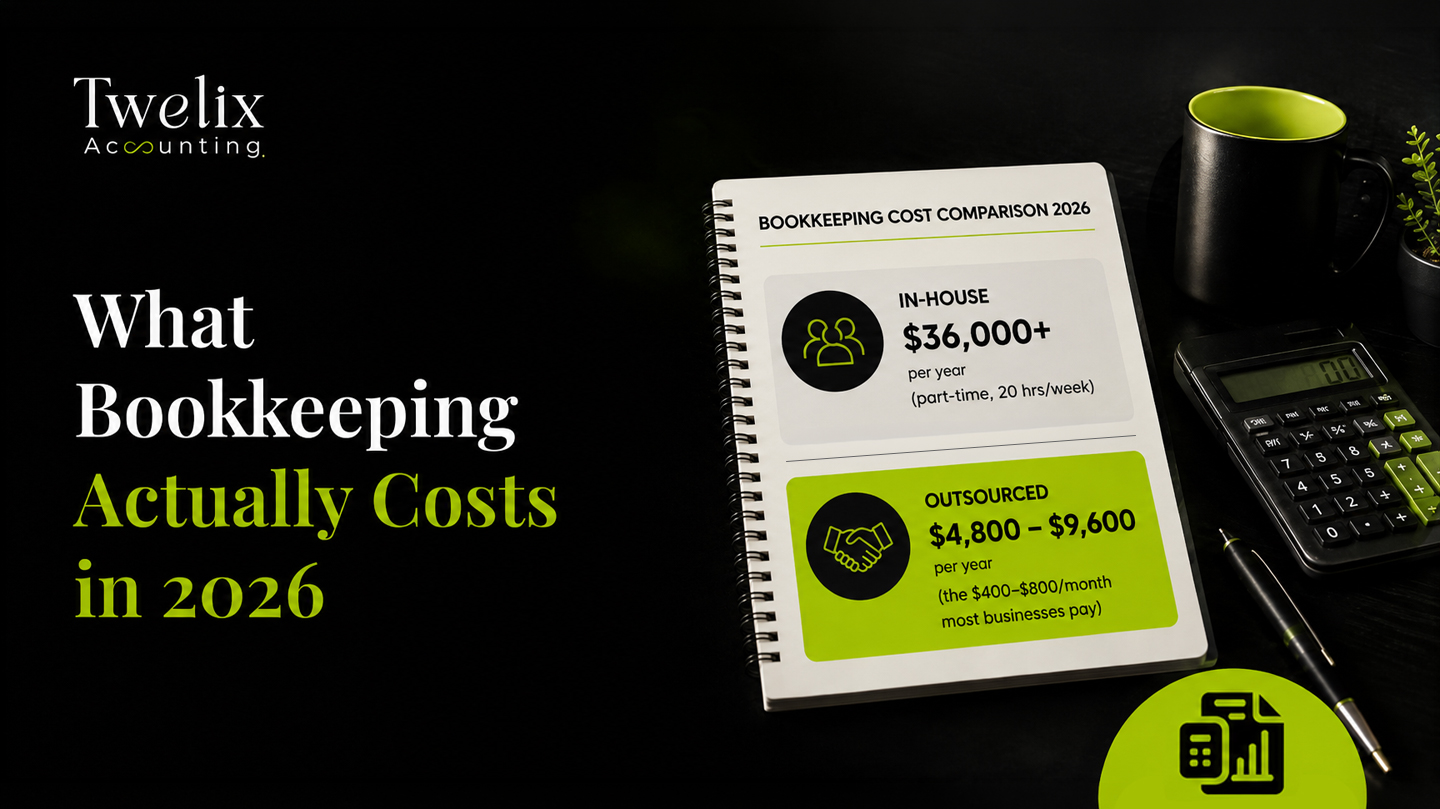
- Most US small businesses pay $300 to $1,500 a month for ongoing bookkeeping in 2026, and most land between $400 and $800.
- Transaction volume drives the price more than revenue or headcount, because bookkeeping hours track transactions.
- Cash-basis bookkeeping runs 25 to 35 percent cheaper than accrual, so check which basis each quote assumes.
- A 20-hour-a-week in-house bookkeeper costs $36,000 and up in the first year once benefits and payroll taxes are counted.
- Catch-up work on prior months is priced separately from the monthly fee, typically at $1,000 to $5,000.
In this article
- The Short Answer
- Find Your Band in 10 Seconds
- What You Will Actually Pay in 2026
- What Actually Moves the Number
- Which Pricing Model Fits Your Business
- What a Part-Time In-House Hire Really Costs
- How Much Should a Small Business Spend on Bookkeeping?
- How to Compare Two Quotes Fairly
- So What Should You Budget?
- Frequently asked questions
Three providers quoted the same business last month. Same books, same software, same twelve months of transactions.
The first said $250 a month. The second said $600. The third said $1,400.
None of them was lying, and none of them was overcharging. They were quoting three different jobs and calling all three "bookkeeping."
That is the actual problem with pricing in this industry. The number is not the hard part. The hard part is working out what sits behind it, because a quote only means something once you know what scope, what basis, and what level of review it assumes.
Here is what the work costs in 2026, what moves the number up and down, and how to read two quotes that look nothing alike.
The Short Answer
#Most US small businesses pay $300 to $1,500 a month for ongoing bookkeeping in 2026, with the majority landing between $400 and $800. Hourly billing runs $30 to $90 an hour. Flat-rate monthly pricing covers a defined scope for a fixed fee. Volume-banded pricing ties the fee to transaction count. One-time catch-up work is quoted separately at $1,000 to $5,000.
Find Your Band in 10 Seconds
#Answer three questions and you will know roughly where you land before you read another word.
- Monthly transactions? Under 100 · 100 to 500 · Over 500
- Bank and card accounts to reconcile? 1 to 2 · 3 to 5 · 6 or more
- Cash or accrual? Cash is cheaper. Accrual costs 25 to 35 percent more
| If you answered | You are in this band |
|---|---|
| Mostly the first option | $200 to $400 a month |
| Mostly the middle option | $400 to $800 a month |
| Mostly the third option | $800 to $1,800 a month |
| Any of the above, plus inventory, payroll, or a second entity | Add $300 to $1,500 |
Everything after this explains why your band is your band, and what would move you out of it.
What You Will Actually Pay in 2026
#Four pricing models cover almost every quote you will receive. They are not interchangeable, and the same business can get wildly different numbers depending on which model a provider uses.
| Model | A business here looks like | 2026 range | What you are billed for | What makes it jump |
|---|---|---|---|---|
| Flat monthly | Steady volume, books current, wants one predictable number | $300 to $1,500 | A defined scope, delivered every month for a fixed fee | Adding payroll, sales tax filing, AP or AR management, or a second entity |
| Hourly | Books behind, or scope nobody can pin down yet | $30 to $90 per hour | Time actually worked, invoiced in arrears | Messy source records. Every extra hour is billable, so disorganization costs you directly |
| Volume-banded | Seasonal swings, or volume growing fast | $200 to $4,000+ | A tier set by monthly transaction count | Crossing a band threshold. Going from 480 to 520 transactions can move you a full tier |
| Software-managed | Solo or side business, cash basis, under 100 transactions | $200 to $500 | A platform with light human review | Anything outside the standard workflow. These tiers assume simple, cash-basis books |
Where businesses actually land, by size:
- Solopreneurs and side businesses: $200 to $400 a month
- Small businesses, 200 to 500 monthly transactions: $600 to $1,800
- Mid-size, above $500K monthly revenue: $1,800 to $4,000
Two things worth knowing before you compare anything. Cash-basis bookkeeping runs 25 to 35 percent cheaper than accrual, so a quote that looks low may simply be quoting a different accounting basis. And catch-up work on prior months is always priced separately from the monthly fee, typically $1,000 to $5,000 depending on how far back the gap runs.
What Actually Moves the Number
#Four things drive the price. Everything else is noise.
Transaction volume
This is the single largest factor, and it is why "how big is your business" is the wrong question. Bookkeeping hours track transactions, not revenue or headcount.
A consulting firm billing $2 million a year on twelve monthly invoices is cheap to maintain. A coffee shop doing $600,000 across thousands of card swipes is not. You almost certainly do not know your transaction count, and you do not need software to find it. Open last month's bank statement and count the lines. Do the same for every card. Add them up. That total, give or take, is what a provider is pricing.
Do that before you ask for a quote. Any provider who does not ask for that number is guessing at your price, which means you will be repriced later.
Bank and card accounts
Every account is a separate reconciliation. Two accounts is routine. Nine accounts, including three credit cards, a merchant processor, and two savings accounts nobody uses, is a materially bigger job at the same transaction volume.
This is the cheapest thing on the list to fix. Closing dormant accounts before you onboard reduces your quote permanently.
Months behind
If your books are current, you are buying maintenance. If you are eight months behind, you are buying maintenance plus a rebuild, and those are separately priced.
Catch-up work is quoted as a one-time project because the effort has no relationship to your ongoing monthly volume. It depends on how far back the gap runs and how much source documentation survived. That is why cleanup pricing is quoted separately from monthly work. For the timeline, see how long a cleanup takes and what to gather first.
Being behind costs more than the cleanup fee once a filing deadline is involved. Every month of the tax year has to be reconciled before a preparer can start, so the return date quietly sets the date your books actually have to be finished.
Industry complexity
Some industries carry structural accounting work that others simply do not have.
Inventory is the clearest example. Perpetual tracking, COGS calculation, and reconciliation to physical counts can add $300 to $1,500 a month to an otherwise comparable quote. That is why ecommerce bookkeeping prices above a service business of identical revenue. Multi-channel sellers add another layer, since each channel settles differently and needs reconciling on its own terms.
Construction carries job costing. Restaurants carry daily sales reconciliation and tip allocation. Professional services carry almost none of this, which is why they sit at the bottom of every pricing range.
Which Pricing Model Fits Your Business
#Match your situation to the row, then read across.
| Your situation | Best-fit model | Why | Watch out for |
|---|---|---|---|
| Books are current, volume is steady | Flat monthly | Predictable cost, and the provider carries the risk of a heavy month | Scope creep. Get the inclusions in writing |
| Books are behind, scope unclear | Hourly, then flat | Nobody can price a cleanup accurately before seeing the file | An open-ended hourly engagement that never converts to flat |
| Volume swings seasonally | Volume-banded | The fee follows the work rather than an annual average | Band thresholds. Ask what happens in a spike month |
| Simple, cash-basis, low volume | Software-managed | Cheapest legitimate option at genuinely simple scope | Anything unusual falls outside the workflow and gets billed or declined |
| Inventory, multi-entity, or multi-channel | Flat monthly, specialist | The complexity is structural and needs someone who has seen it | Generalist quotes that look cheap because they have not scoped the inventory work |
The pattern across that table: hourly is right for uncertainty, flat is right for everything ongoing. Most of the industry has moved to flat monthly pricing for continuing work, and the reason is not generosity. Hourly billing rewards a provider for taking longer, which is a poor foundation for a long relationship.
What a Part-Time In-House Hire Really Costs
#Most owners compare a monthly quote against a part-time salary and conclude that hiring is cheaper. The comparison is wrong, because salary is not the cost of an employee.
The Loaded-Cost Multiplier is the number that fixes it. According to the US Bureau of Labor Statistics, wages and salaries make up only 69.9 percent of what private-sector employers actually spend on an employee. Benefits account for the other 30.1 percent. Divide one by 0.699 and you get the multiplier: every dollar of wage costs an employer about $1.43.
That figure is not an estimate from a staffing company. It is the BLS Employer Costs for Employee Compensation series, March 2026.
Here is what it looks like on a real part-time seat. The median US wage for bookkeeping, accounting, and auditing clerks is $49,210 a year, which is $23.66 an hour. At 20 hours a week:
| Line item | Annual cost |
|---|---|
| Base pay, 20 hrs/week at $23.66 | $24,605 |
| Employer payroll taxes (FICA 7.65%, FUTA 0.6% net, plus state unemployment) | starts at $2,030 |
| Insurance, paid leave, and other benefits | the balance of the 43% loading |
| Subtotal at the BLS 1.43× multiplier | $35,172 |
| Accounting software seat (QuickBooks Online) | $360 to $1,080 |
| Workspace, equipment, and IT | price your own |
| Recruiting and onboarding, first year | price your own |
| Realistic first-year total | $36,000 and up |
That is roughly $3,000 a month for 20 hours a week of capacity. It does not count your own time managing the person, or what happens to the books when they take a holiday.
Set that against $400 to $800 a month for a flat-rate outsourced engagement covering the same scope, and the arithmetic stops being close. There is a real exception. If you need more than about 25 hours a week of finance work, or you need someone physically present, an in-house hire starts making sense on its own terms.
How Much Should a Small Business Spend on Bookkeeping?
#As a working benchmark, most US small businesses spend 1 to 3 percent of annual revenue on bookkeeping and basic accounting. Simple service businesses sit at the bottom of that band. Inventory-heavy and multi-entity businesses sit at the top.
Run the check against your own numbers. At $500,000 of revenue, 1 to 3 percent is $5,000 to $15,000 a year, or roughly $420 to $1,250 a month. If your quote sits inside that band and the scope is right, you are paying a normal price.
The more useful question is what underspending costs. Books that are wrong are more expensive than books that are expensive:
- Missed deductions, because the expense was never categorized correctly
- Filing extensions and amended returns, both of which carry professional fees
- Decisions made on numbers that were 90 days stale
- Cleanup fees later, which cost more than doing it right the first time
Underspending rarely shows up as a line item. It shows up as a tax bill that was larger than it needed to be.
How to Compare Two Quotes Fairly
#Two quotes are comparable only when you know they describe the same job. Demand these five things in writing before you compare any numbers.
- Cash or accrual basis. This alone moves a quote by 25 to 35 percent.
- How many accounts are reconciled, named individually. Not "your accounts."
- The monthly transaction ceiling included in the fee, and the price above it.
- What is excluded. Payroll, sales tax filing, AP and AR, and 1099s are commonly outside a base fee.
- The delivery date each month, and who reviews the file before it reaches you.
Then ask two questions that cost nothing and tell you a great deal. Who actually performs the work, and who reviews it before it reaches me? A provider who cannot name the review step does not have one.
For what it is worth on our side: Twelix quotes flat monthly rates with the transaction ceiling stated up front, delivers by the 10th, and every file is reviewed before it goes out. We are ISO 27001 certified and hold QuickBooks ProAdvisor certification at Levels 1 and 2, along with Sage Intacct and Bill.com certifications. Our credentials are listed in full, and you should ask any provider you are considering for the equivalent.
So What Should You Budget?
#If your books are current and your business is straightforward, budget $400 to $800 a month and expect that to hold as you grow, until inventory, payroll, or a second entity enters the picture.
If you are behind, budget the cleanup separately as a one-time cost. Do not let it get folded into a monthly fee, because that hides how much you are paying for each.
And if a quote comes in far below everything you have read here, the scope is different. Find out how before you sign, not after.
Since this article spends its length telling you to demand numbers, here are ours. Outsourced bookkeeping starts at $398 a month. Enterprise-level accounting, with deeper reporting and financial control, starts at $1,498 a month. One-time cleanup starts at $998 and is quoted separately from monthly work, for the reason given above. Where you land inside those ranges depends on the same four things this article has been about: transaction volume, account count, accounting basis, and whether payroll or inventory is in scope.
So which quote should that business have taken?
The one from the opening. Here is what those three numbers actually covered.
The business ran about 400 monthly transactions across six accounts, on accrual basis, with no inventory and no payroll.
The $250 quote was cash basis, two accounts, and a 150-transaction ceiling, with no review step before delivery. It would have breached the ceiling in month one and been repriced, and the books would not have been on the basis the business actually needed.
The $1,400 quote was correct work, priced for payroll and inventory the business did not have. Real scope, wrong business.
The $600 quote covered all six accounts on accrual, with a transaction ceiling above where they were running and a review step before delivery. That was the right answer, and it was the middle number.
The lesson is not that the middle quote is always right. It is that all three were honest prices for three different jobs, and the only way to see that was to ask what each one included. Ten minutes of questions would have shown it. Nobody asked.
That is the work we do, at a flat monthly rate with the scope written down. If a simpler option fits you better, we will say so.
Frequently asked questions
How much does bookkeeping cost per month?
Most US small businesses pay between $300 and $1,500 a month for ongoing bookkeeping in 2026, with the majority landing in the $400 to $800 range. Solopreneurs and side businesses typically pay $200 to $400. Businesses running 200 to 500 monthly transactions generally pay $600 to $1,800. Mid-size businesses above $500,000 in monthly revenue commonly pay $1,800 to $4,000. The spread is driven mostly by transaction volume, the number of accounts being reconciled, whether you need accrual or cash basis, and whether payroll and inventory are in scope. Catch-up work on prior months is quoted separately from the monthly fee.
How much does it cost to outsource bookkeeping?
Outsourcing generally costs $300 to $1,500 a month for a small business, which usually compares favorably with hiring even part-time. The reason is employer overhead. Bureau of Labor Statistics data shows wages make up only 69.9 percent of what employers actually spend on staff. A $24,600 part-time wage therefore becomes roughly $35,000 once benefits and payroll taxes are counted, before software or workspace. An outsourced engagement carries none of that, and no recruitment cost. The trade is that you get defined scope rather than open availability, which is why businesses needing more than roughly 25 hours a week of finance work often still hire.
Why do bookkeeping quotes vary so much for the same business?
Because they are usually quoting different jobs. The most common cause is accounting basis, since cash-basis work runs 25 to 35 percent cheaper than accrual and many quotes do not state which they assume. The second is transaction ceilings, where a low fee may cover far fewer transactions than you actually process. The third is exclusions, with payroll, sales tax filing, AP and AR management, and 1099 preparation frequently priced outside a base fee. The fourth is review, since a quote with no human review step before delivery costs less to produce. Ask every provider to state all four in writing and the quotes usually become comparable.
How much should a small business spend on bookkeeping?
Most US small businesses spend between 1 and 3 percent of annual revenue on bookkeeping and basic accounting. Simple service businesses sit at the lower end, while inventory-heavy, multi-entity, and multi-channel businesses sit at the top. At $500,000 of annual revenue that works out to roughly $420 to $1,250 a month. Treat the benchmark as a sanity check rather than a target, because your transaction volume matters far more than your revenue. The larger risk is usually underspending, since incomplete books produce missed deductions, filing extensions, amended returns, and cleanup costs that exceed what proper bookkeeping would have cost.
Is per-hour or flat-rate bookkeeping better?
Flat rate is better for ongoing monthly work and hourly is better for uncertain scope. Hourly billing, at $30 to $90 an hour in 2026, makes sense for catch-up projects and cleanups where nobody can accurately predict the effort before seeing the file. For continuing work it creates two problems: your cost becomes unpredictable month to month, and the provider is rewarded for taking longer. Flat-rate pricing fixes both by pricing a defined scope, which is why most of the industry has moved to it for ongoing engagements. If a provider offers only hourly for continuing monthly work, ask why.

CA Jaimin M.
Founder & CEO, Twelix Accounting
Published
Jaimin M. is the founder and CEO of Twelix Accounting, where he leads strategy and overall direction. A Chartered Accountant with more than eight years in U.S. accounting, he shapes how Twelix delivers outsourced bookkeeping and accounting services to small businesses. When he is not running the company, he is deep in a game, insisting it is helping his strategy skills.
Connect on LinkedIn