Key takeaways
- Florida's minimum wage reached $15.00 an hour on September 30, 2026, and from 2027 it is recalculated every year for inflation with no ceiling.
- At $15 an hour, full time, the wage is $31,200 a year. At the BLS compensation multiplier of 1.43, the loaded cost is $44,616 a year, or $3,718 a month.
- That loaded figure still leaves out software, training, errors caught late, and the cost of replacing the employee.
- A flat monthly bookkeeping engagement has no wage to load, and it is sized to your transaction volume rather than to a payroll rate.
In this article
- What Florida's $15 minimum wage means if you have in-house bookkeeping help
- The real cost of an in-house employee isn't the hourly wage
- What Outsourced Bookkeeping Florida Businesses Actually Get
- "I already have someone doing my books" and other pushback
- The honest downside
- What working with Twelix looks like
- Conclusion
- Frequently asked questions
A Florida small business owner is running payroll, wondering if outsourced bookkeeping Florida providers offer might be cheaper than what they're paying now. Florida's minimum wage crossed $15 an hour on September 30, 2026. The employee who reconciles invoices and pulls together monthly reports just got a raise. They didn't ask for it. The law raised it for them. The owner does the math on the back of an envelope: $15, times 40 hours, times 52 weeks. Then they stop. That number isn't the real one. Payroll taxes. Unemployment insurance. A software subscription. Two weeks every January spent training whoever replaces last year's employee. Florida's new wage floor didn't just raise one line on a paycheck. It raised the floor under everything an in-house employee costs. Most small business owners have never actually added it up.
Quick answer
Florida's $15-an-hour minimum wage, effective September 30, 2026, raises the cost floor for anyone you employ in-house, including someone who handles your books. That floor keeps climbing every year starting in 2027, with no ceiling. Once payroll taxes, benefits, training, and turnover are counted, outsourced bookkeeping now costs many Florida small businesses less than an in-house employee, without the risk of managing one.
What Florida's $15 minimum wage means if you have in-house bookkeeping help
#Florida's minimum wage reached $15.00 an hour on September 30, 2026. It was $14.00 an hour the year before. Both increases are steps in the same plan. Florida voters approved a constitutional amendment in November 2020. It raised the wage every September 30 until it hit $15 in 2026. This was the final scheduled step.
It applies to every employer in the state. There's no small-business exemption and no carve-out for administrative roles. If you have anyone on payroll in Florida, including someone handling reconciliations, invoices, or month-end reports, their pay floor moved with the law.
The increases don't stop here. Starting in 2027, Florida's Department of Commerce recalculates the minimum wage every year based on inflation. It uses the Consumer Price Index for urban wage earners (CPI-W). The state sets the new rate each September 1. It takes effect the following January 1. There's no ceiling written into the amendment. Whatever your in-house bookkeeping help costs you today, that's the floor for next year, not a number you can plan around long-term.
None of this is about where you employ someone or how you structure your team. It's about what the law now requires you to pay, if you keep this work in-house.
The real cost of an in-house employee isn't the hourly wage
#Outsourced bookkeeping is a service. A provider handles your reconciliations, categorization, and monthly financial reports for a flat fee. It runs inside your existing accounting software. You don't employ someone in-house to do the same work.
Here's what $15 an hour actually costs a Florida business, once the wage itself isn't the only number on the page.
Start with base pay: $15 an hour, 40 hours a week, 52 weeks a year. That's $31,200 in wages alone. It's the number on the envelope. It isn't the number on the balance sheet.
The U.S. Bureau of Labor Statistics tracks what employers actually spend beyond wages. That includes payroll taxes, unemployment insurance, workers' compensation, and benefits. In its most recent release, wages make up 70.0 percent of total employer compensation costs in private industry. The remaining 30.0 percent goes to those additional costs. That works out to a loading factor of roughly 1.43. Total compensation runs about 43 percent above the wage itself. Twelix uses this same BLS methodology in a full cost breakdown elsewhere on this site, linked below. The math here isn't new. Only the input has changed: Florida's new $15 floor.
| Cost component | Annual | Monthly |
|---|---|---|
| Base wage at Florida's $15/hour minimum | $31,200 | $2,600 |
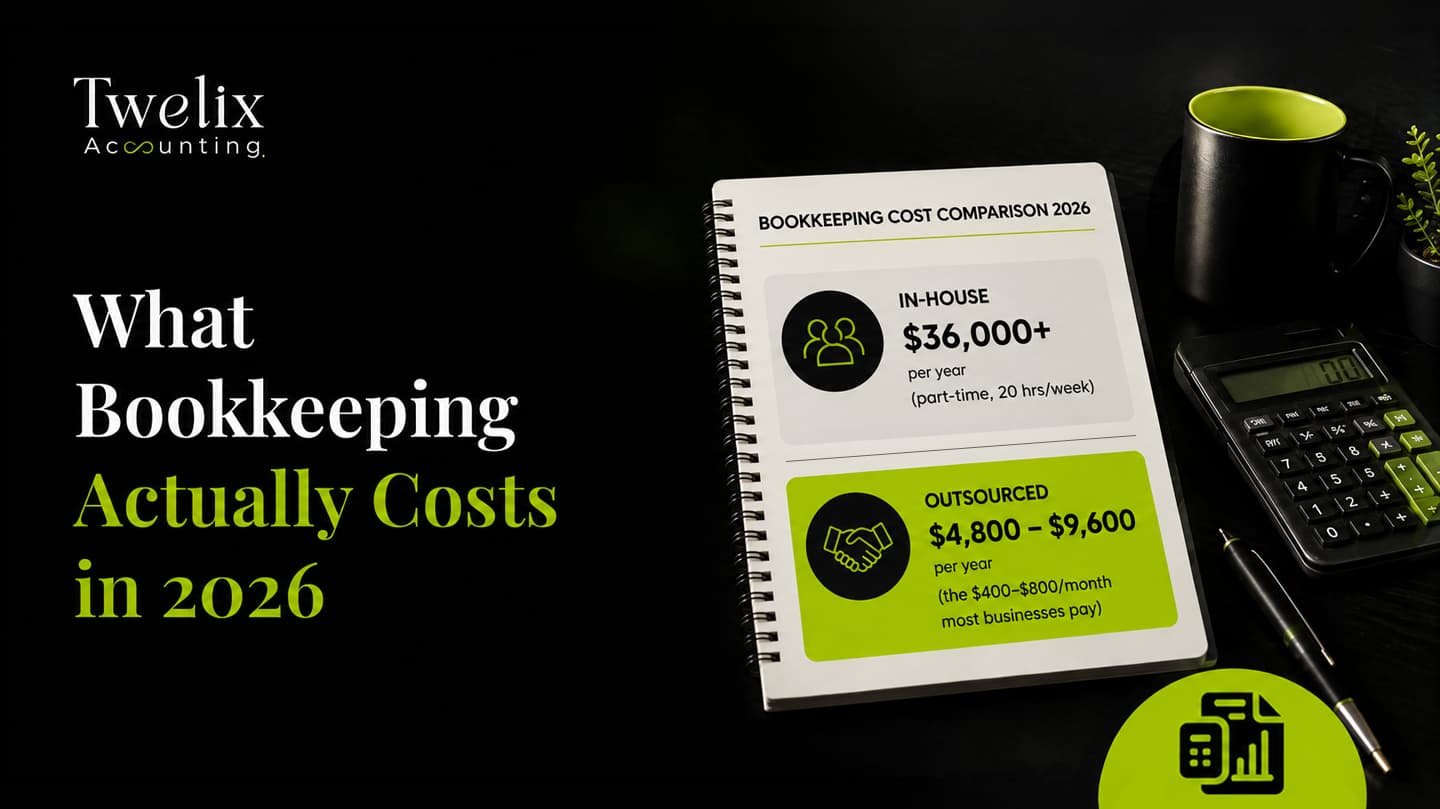
| Loaded cost at BLS's 1.43x compensation multiplier | $44,616 | $3,718 |
That $44,616 figure is the BLS-modeled floor for payroll taxes, unemployment insurance, workers' compensation, and standard benefits alone. It doesn't include several other real costs. This team hasn't put a dollar figure on them, because they vary too much from one business to the next to state as a single number:
- Software licenses for whatever accounting platform the employee uses
- Onboarding and ongoing training time, especially during a gap between employees
- The cost of a mistake in the books that isn't caught until tax season
- The cost of replacing the employee if they leave, particularly around tax deadlines
Every one of those adds to the $44,616 floor. None of them subtracts from it.
Here's what that looks like next to a flat monthly engagement instead of an hourly wage.
| Monthly cost | |
|---|---|
| In-house employee at Florida's new $15/hour minimum (fully loaded) | $3,718 |
| Twelix monthly bookkeeping engagement | Starting from around $500, and lower for light transaction volume or a smaller scope |
These aren't quite the same thing. One number is the full cost of one full-time person. The other is a service sized to how much bookkeeping your business actually generates, and it moves with your transaction volume rather than with a wage. A business with lighter monthly activity can land well under the $3,718 in-house floor. A business with heavier volume will land somewhere between the two. Either way, there's no per-hour rate to negotiate and no number that climbs every September.
For the fuller version of this math, including how the loading factor applies to other roles, see how much bookkeeping actually costs.
What Outsourced Bookkeeping Florida Businesses Actually Get
#The Hidden Payroll Tax is the gap between what an employee's paycheck shows and what that employee actually costs. Payroll taxes, unemployment insurance, workers' compensation, and standard benefits all add to that gap. For a $15-an-hour employee in Florida, that gap adds roughly 43 percent on top of the wage. And that's before training, software, or turnover are counted at all.
A flat monthly bookkeeping engagement sidesteps that whole calculation. There's no wage to load in the first place. You pay one number a month. It covers reconciliations, categorization, monthly financial reports, and cleanup when the books need it. A provider delivers this with a team behind the work, not one person who can quit, get sick, or go on leave during your busiest month.
That team structure is the practical difference most business owners underweight. An in-house employee is a single point of failure. A provider's engagement isn't, because the work doesn't stop if one person is unavailable.
For the full breakdown of what a monthly engagement includes, what it doesn't, and how the onboarding and handoff process works, see what outsourced bookkeeping is.
"I already have someone doing my books" and other pushback
#A few objections come up every time this topic gets raised. They deserve straight answers, not a sales pitch.
"I'm loyal to the person who's been doing this for years." That loyalty is real, and it isn't nothing. It also isn't a cost figure. Loyalty and the BLS-modeled $44,616 floor are two separate questions. A business can weigh both without pretending one cancels out the other.
"Switching mid-year sounds disruptive." It's a fair worry. It's also the most common reason businesses put this decision off past the point where it would have helped. A properly run handoff doesn't require switching mid-fiscal-year at all. Most transitions are timed around a quarter or month-end close, specifically to avoid disruption.
"I don't know if I can trust someone outside the business with this." This is usually the real objection underneath the other two. It's worth answering directly rather than dancing around it. The trust concern, the turnover risk, and what a switch actually looks like week by week are covered in full in virtual bookkeeping versus in-house, including exactly what access a provider has, what you keep control of, and how the six weeks after signing tend to go.
The honest downside
#In-house bookkeeping still wins for some businesses. It's worth saying plainly rather than burying it. If you need same-day turnaround on payment approvals, or your transaction volume is high enough to keep one person fully busy every day, an in-house employee physically present in your office can outperform a monthly engagement on responsiveness alone.
There's also a real handoff period any time you switch. Someone has to learn your chart of accounts, your vendor list, and the quirks of how your business runs its books. That takes a few weeks even when the switch goes well. Some owners also simply prefer having someone in the building they can walk over to. That preference is legitimate, even when the math points the other way.
What Florida's new wage floor changes isn't whether in-house bookkeeping can work. It's the price of keeping it, and that price is higher than it was a year ago. It will be higher again next year. For the full comparison of where each model wins, including a transaction-volume breakdown, see the virtual versus in-house post linked above.
What working with Twelix looks like
#Twelix runs a flat-rate monthly engagement. One price, no hourly billing, month-to-month, with no long-term contract. It starts with a complimentary Books Review: a free 30-minute look at where your books currently stand. That covers your reconciliation status, your month-end close workflow, and whether your current reporting is actually usable for decisions. You get a written quote within 24 hours of that call. Onboarding typically takes 48 hours once you decide to move forward. Twelix works inside the accounting software you already use, including QuickBooks and Xero, so there's no forced migration to a new platform.
Clients span construction, ecommerce, professional services, hospitality, and more, so the engagement is scoped to how your business actually runs, not a one-size template. See real client results across those industries in Twelix's case studies.
On the trust question raised above: Twelix is ISO 27001 certified for information security and SOC 2 Type II audited, with GDPR and HIPAA-aligned practices for client data. The team includes Intuit QuickBooks ProAdvisors, Sage Intacct certified staff, and Bill.com certified staff. Each client gets an assigned resource familiar with their industry, not a rotating queue. Monthly close is delivered by the 10th, every month.
Conclusion
#The real problem isn't Florida's minimum wage. It's that most small business owners have never actually totaled what in-house bookkeeping costs beyond the paycheck. The $15 wage floor just made that number bigger, and it will keep climbing every year with no ceiling.
Outsourced bookkeeping Florida small businesses can access removes that calculation entirely. There's no wage to load, no payroll tax percentage to track, no turnover risk during tax season, and no single point of failure. You get a flat monthly price and a team behind the work instead.
Want to see where your own books stand against that $44,616 floor? A Books Review takes 30 minutes and costs nothing to find out.
Frequently asked questions
Is it cheaper to keep bookkeeping in-house or outsource it for a Florida small business?
For most Florida small businesses, outsourced bookkeeping now costs less than an in-house employee once the full cost is counted. An in-house employee paid Florida's $15-an-hour minimum wage costs roughly $44,616 a year once payroll taxes, unemployment insurance, workers' compensation, and standard benefits are added, using the U.S. Bureau of Labor Statistics' compensation-cost data. That figure doesn't include software, training time, or the cost of covering a gap when that employee is out or leaves. A flat monthly bookkeeping engagement replaces that entire calculation with one predictable price and removes the turnover risk. The right answer still depends on your transaction volume and how much same-day, in-person turnaround your business needs, but for most small businesses handling a typical monthly transaction load, the outsourced model now wins on cost alone.
What does outsourced bookkeeping actually include?
A flat monthly bookkeeping engagement typically covers transaction categorization, bank and credit card reconciliations, monthly financial statements (a profit and loss statement and a balance sheet at minimum), and ongoing cleanup if your books have fallen behind. Most providers, including Twelix, work inside the accounting software you already use rather than requiring you to switch platforms. You get a team behind the work instead of one person, and reporting is delivered on a fixed monthly schedule rather than whenever an in-house employee gets to it. The full scope, including what most engagements don't cover, such as tax filing or payroll processing, is detailed in this site's outsourced bookkeeping overview.
Will I lose control over my books if I outsource?
No, not if the engagement is set up correctly. You retain administrator-level access to your own accounting software at all times, and a reputable provider works as a layer on top of your existing system rather than replacing your visibility into it. You can see every transaction, every reconciliation, and every report as it's produced. The actual difference is who does the data entry and reconciliation work day to day, not who owns or can see the data. Providers with independent security certifications, such as ISO 27001 or SOC 2, also document exactly what access they hold and how it's removed if you ever end the engagement.
How does Florida's rising minimum wage affect small businesses beyond bookkeeping?
Florida's minimum wage reached $15.00 an hour on September 30, 2026, the final step of a 2020 constitutional amendment. It applies to every hourly role at every Florida employer, not just bookkeeping. Starting in 2027, the state recalculates the minimum wage annually based on inflation, with the new rate set each September 1 and taking effect the following January 1. There's no ceiling on future increases. Any role currently paid near minimum wage, whether it's administrative work, retail, food service, or bookkeeping, will see its cost floor rise again next year and every year after that. Businesses that build recurring wage growth into their planning, rather than treating each increase as a one-time event, are better positioned for what comes next.
How do I switch from an in-house employee to outsourced bookkeeping without disruption?
Most transitions are timed around a month-end or quarter-end close, not mid-cycle, specifically to avoid disruption to your reporting. The process typically starts with a review of your current books to establish a clean starting point, followed by access setup in your existing accounting software, so there's no data migration required. A provider then takes over reconciliations and reporting going forward while confirming your historical books tie out correctly. With Twelix specifically, onboarding typically takes about 48 hours after you sign on, following a free Books Review that identifies exactly where your books stand before the switch happens.

CA Jaimin M.
Founder & CEO, Twelix Accounting
Published
Jaimin M. is the founder and CEO of Twelix Accounting, where he leads strategy and overall direction. A Chartered Accountant with more than eight years in U.S. accounting, he shapes how Twelix delivers outsourced bookkeeping and accounting services to small businesses. When he is not running the company, he is deep in a game, insisting it is helping his strategy skills.
Connect on LinkedIn