Key takeaways
- Restaurant accounting runs on a weekly number: prime cost (food and beverage cost plus total labor, divided by sales), checked every Monday. The article calls it the Monday Number.
- Tips are a liability from the moment a card batch settles, never revenue. Employees with $20 or more in monthly tips report them by the 10th, and establishments with more than 10 employees file Form 8027.
- A comp is booked as a sale at full price and backed out through a comp expense line. A void kills the order before the kitchen makes anything, so nothing is booked.
- A monthly P&L misleads in five ways: cadence, no inventory count, unrecorded comps, tips running through revenue, and cash-basis timing.
In this article
- Restaurant Accounting Is a Weekly Job, Not a Monthly One
- Restaurant Prime Cost: The One Number to Track Every Week
- Food Cost Variance: What the Recipe Says vs What Left the Walk-In
- Comps and Voids: Book Them or Your Food Cost Lies
- Tips Are a Pass-Through, Not Revenue
- Why Your Monthly P&L Lies to You
- What a Restaurant P&L Should Include
- What You Get From Twelix
- Frequently asked questions
Your monthly P&L says you made a profit. Your bank account says something else. Both are telling the truth. The P&L is just late.
That gap is the real problem with monthly accounting alone. Food cost and labor both move daily. A number that lands ten days into the next month describes a kitchen that no longer exists.
Restaurants do not need a better monthly statement. They need a faster number, checked every week instead of once a month. Most owners accept the lag as the cost of doing business. It is not. It is a choice, and most of the time nobody told them they were making it.
Quick answer
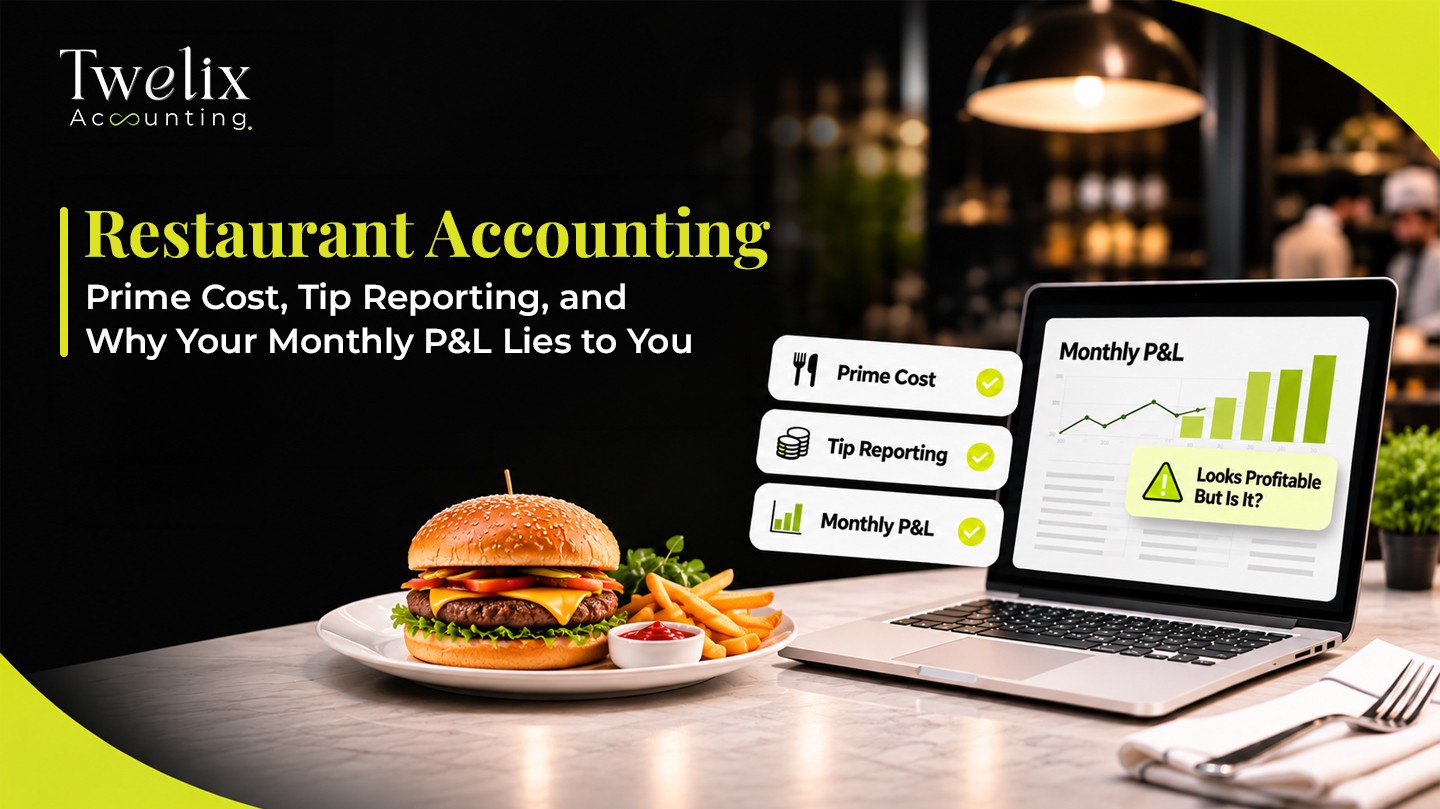
Restaurant accounting runs on a weekly number, not a monthly statement. Prime cost, food and beverage cost plus total labor, divided by sales, belongs on your desk every Monday morning. Tips are a liability from the moment a card batch settles, never revenue. A comp gets booked as a sale, then backed out as an expense, so food cost stays honest. A monthly P&L hides a bad week behind a good one.
Restaurant Accounting Is a Weekly Job, Not a Monthly One
#Call it the Monday Number. It is last week's prime cost, as a percentage of last week's sales, calculated and on your desk every Monday morning.
Most restaurant owners only see a number like this once a month, usually well past the middle of the following month. By then it describes a kitchen that no longer exists. Food cost and labor both move daily, not monthly.
Your tax preparer and your lender still need the monthly P&L. But it is the wrong tool for running tonight's kitchen, because it answers a question about last month while you are deciding tomorrow's order.
The Monday Number does not replace the monthly P&L. It sits alongside it, answering a faster question: not "did we make money last month," but "is this week's kitchen running the way it should."
A restaurant that checks prime cost once a month is driving by looking in the rearview mirror. The road ahead needs its own number, checked weekly, while there is still time to act on it.
If the only prime cost figure you have ever seen is the one buried in a report your accountant emails three weeks into the next month, you do not have a system. You have a postmortem.
Restaurant Prime Cost: The One Number to Track Every Week
#Prime cost is the simplest formula in restaurant accounting, and the most important one.
Prime cost = (food and beverage cost + total labor cost) ÷ total sales.
Most full-service restaurants run healthiest somewhere around 60 percent. Quick-service concepts, with lighter labor per ticket, typically run a few points lower. This is not a figure from a published industry study. It is the working target we use across the restaurant clients we work with, stated here as our own benchmark, not dressed up as a universal standard.
If you are sitting above 65 percent for more than two weeks running, stop and go find out why before you do anything else. That is not a seasoning problem or a slow Tuesday. It is pricing, portioning, or staffing, and every week you let it run is a week of margin you do not get back.
You do not need a full monthly close to calculate this every week. Four inputs, pulled from things you already have:
- Sales: your POS batch report for the week.
- Purchases: the week's vendor invoices, food and beverage only.
- Labor: the payroll register for the week, plus employer-side payroll taxes.
- A quick count: a Sunday-night check of your ten highest-cost items, not a full physical count.
Here is a worked week, for illustration only, not a benchmark to match exactly:
| Line | Amount |
|---|---|
| Sales (POS batch) | $42,000 |
| Food and beverage cost | $13,440 |
| Total labor cost | $11,760 |
| Prime cost | $25,200 |
| Prime cost percentage | 60.0% |
That is a 15-minute exercise most Monday mornings, not a reporting project. The point is not precision to the penny. The point is catching a week that is drifting before it becomes a month that is drifting.
Food Cost Variance: What the Recipe Says vs What Left the Walk-In
#Your recipes say one thing. Your walk-in says another. The gap between them has a name: food cost variance.
Theoretical cost is what your recipes predict: the standardized cost of every dish, multiplied by how many of each you sold. Actual cost is what really left the building: opening inventory, plus purchases, minus closing inventory, for the same period.
When theoretical and actual do not match, the gap lives in one of four places: waste (trim, spoilage, a plate sent back), over-portioning (a heavier pour than the recipe calls for, across hundreds of plates), theft, or unrecorded comps.
Price this for your own restaurant before moving on. Take one point of variance, one percent of your weekly food cost, and multiply it by your actual weekly food spend. That single percentage point, run across a year, is usually large enough to get everyone's attention.
Most owners who say they have a food cost problem have never actually measured it. They have a feeling, built from a tighter month or a vendor price hike, not a number. Measure it first. The fix is cheap. Guessing at the fix is not.
Comps and Voids: Book Them or Your Food Cost Lies
#A void and a comp are not the same event. Treating them the same is one of the fastest ways to corrupt your food cost number.
A void kills an order before the kitchen ever touches it. No food was made, so there is nothing to book. It should simply disappear from the ticket.
A comp is different. The food was made, plated, and served. The guest did not pay, but the kitchen still spent the ingredients and the labor to produce it. Book it at full menu price as a sale. Then back it out through a dedicated comp expense line. This keeps food cost attached to the sale it actually came from, and it keeps your sales line showing real demand.
Every comp should carry a reason code (service recovery, manager discretion, marketing, staff meal) and a manager's name attached to it. Read that list every Monday, alongside prime cost. A restaurant comping 2 percent of sales with no pattern is very different from one comping 2 percent to the same table every week.
Left unbooked, comps quietly inflate your food cost percentage while making your sales look smaller than they actually were. Both numbers end up wrong. Both point you toward the wrong fix.
A comp log nobody actually reads is not a control. It is a spreadsheet pretending to be one.
Tips Are a Pass-Through, Not Revenue
#Tips are not your restaurant's revenue. They never were. Treating them as if they were is one of the most common ways a restaurant's books stop telling the truth.
Card tips are a liability from the moment a card batch settles until the moment they are paid out to staff. They pass through your account. They do not belong on your revenue line.
Cash tips follow a specific rule. An employee who receives $20 or more in tips in a month must report it to you in writing by the 10th of the following month. Once reported, you withhold income tax and the employee's share of Social Security and Medicare on those tips, same as regular wages.
Restaurants with more than 10 employees on a typical business day carry an additional filing: Form 8027, the large food and beverage establishment tip report. If the tips your staff actually report fall short of 8 percent of your gross receipts, you must allocate the difference to employees' W-2s.
| Obligation | Who it applies to | Deadline |
|---|---|---|
| Employee tip report to employer | Any employee with $20 or more in tips in a month | 10th of the following month |
| Form 8027 filing | Establishments with more than 10 employees on a typical day | Paper: around the last day of February, moved to the next business day on a weekend. Electronic: March 31 |
| Form 8846 credit claim | Any employer with eligible tipped wages | Filed with your annual return |
For the 2026 tax year, that paper deadline falls on March 1, 2027, since the last day of February lands on a Sunday that year. Confirm against the IRS's published instructions closer to filing.
There is also a credit many restaurant owners never claim. Form 8846 lets you claim back the employer's share of Social Security and Medicare tax on tips above a minimum-wage floor set in the statute. It is money sitting on the table every season it goes unfiled, and nobody at the IRS is going to call to remind you it exists.
Why Your Monthly P&L Lies to You
#Call these what they are: five specific ways a standard monthly P&L misleads a restaurant owner, not one vague complaint about accounting.
- Cadence hides the bad week. A rough Tuesday gets absorbed into a strong month and never shows up anywhere. Fix: track the Monday Number weekly, not just monthly.
- No inventory count turns purchases into cost. Without a period-end count, your software reports what you bought, not what you actually used. Fix: count inventory, even roughly, every period you want an accurate cost figure.
- Unrecorded comps distort both lines at once. Food cost looks too high. Sales look too low. Fix: book every comp at full price, then back it out as its own expense line.
- Tips running through the P&L inflate revenue and expense together. If tips sit anywhere near your sales line, both your top line and your labor line are wrong. Fix: route tips as a pass-through liability, never as revenue.
- Cash-basis accounting puts invoices in the wrong month. A large produce invoice that hits your bank in March but covers February service makes February look better than it was. Fix: accrue major invoices to the period the food was actually used.
Most restaurant P&Ls we see carry three of these five by default. Not because anyone made a mistake. Because the accounting software's defaults assume a business simpler than a restaurant actually is.
If your P&L has none of these five problems, you are the exception, not the rule. Worth checking before you assume you are one.
What a Restaurant P&L Should Include
#A restaurant P&L that is actually useful has a specific shape, and most generic templates do not have it. That is why accounting for restaurants cannot lean on a generic template.
Sales by category (food, beverage, catering), with delivery apps shown net of fees. Cost of goods by the same categories, so food and beverage cost read separately. Labor with employer-side payroll taxes included, not just gross wages. A prime cost subtotal line directly below labor, doing the addition for you. Then controllable expenses, occupancy costs, and profit.
If your P&L does not subtotal prime cost on its own line, almost nobody reads past the top of the page. That is the layout built into the monthly package we deliver by the 10th: sales, cost of goods, labor, prime cost subtotal, controllables, occupancy, profit, every month, without you having to ask for it.
What You Get From Twelix
#Twelix Accounting is an outsourced bookkeeping and accounting service serving businesses across the US, and restaurants are a core part of who we serve. Our job is clean books and clear numbers, every month, so you can see where your money is going without having to do the bookkeeping yourself. For a restaurant, that means prime cost, tip reporting, and a P&L built the way this article describes, delivered on a schedule you can count on. Here is what you get when you work with Twelix:
A service built around restaurants, not a generalist process applied to every client the same way. We do not learn how prime cost works on your account. We already know, because restaurants are not a side niche for us, they are a core piece of who we serve.
Your prime cost, calculated and on your desk every Monday, not buried in a monthly close. We pull it from your POS batch, your invoices, and your payroll register, the same way this article just walked through. If your current setup still closes once a month and calls that enough, that gap is the entire reason this article exists.
A monthly package that goes further than a P&L. Profit and loss, balance sheet, cash flow statement, and a written summary of what moved, on your desk by the 10th, every month, without you having to chase it down.
Flat monthly pricing. No hourly billing, no surprise invoice after a busy month, no long-term contract. Month to month, cancel any time.
A quote within 24 hours of a free, 30-minute consultation. Say yes, and your books are live within 48 hours. We tell you the number before you have told us anything beyond what we need to quote it.
Your existing software stays put. Toast, Square, Gusto, QuickBooks, whatever you already run. Nothing gets migrated and nothing you have already built gets thrown out to make room for our process.
ISO 27001 certified, with QuickBooks ProAdvisor, Sage Intacct, and Bill.com certifications on the team. Ask any provider for these before you hand them a bank feed. If they cannot produce them, that is worth knowing before the engagement starts, not after.
Frequently asked questions
What is prime cost in restaurant accounting?
Prime cost is your food and beverage cost plus your total labor cost, divided by total sales, as a percentage. It tells you, week by week, whether your two largest cost categories are in line with what you are selling. Most full-service restaurants run healthiest around 60 percent, with quick-service concepts a few points lower. Prime cost does not replace your monthly P&L. It is a faster, weekly check, calculated from your POS batch, your invoices, and your payroll register, without waiting for a full close.
How do I calculate food cost variance?
Calculate theoretical cost by multiplying each recipe's standardized cost by how many of that dish you sold. Calculate actual cost as opening inventory plus purchases, minus closing inventory, for the same period. Subtract theoretical from actual, and the difference is your variance. A gap almost always comes from waste, over-portioning, theft, or unrecorded comps. Price the gap before deciding it is not worth investigating. One percentage point of variance, run across a year of food spend, is usually large enough to justify fixing.
Do restaurants have to file Form 8027 for tip reporting?
Yes, if you normally employ more than 10 employees on a typical business day and customary tipping applies. Form 8027 reports allocated tips when the tips your staff report fall short of 8 percent of gross receipts; the shortfall is allocated to directly tipped employees and shown on their W-2s. This is separate from the monthly rule that any employee with $20 or more in tips must report that amount in writing by the 10th of the following month. Confirm the exact filing date against the IRS's published instructions each year, since it shifts slightly.
Should comps and voids be recorded the same way?
No. Treating them the same is one of the fastest ways to distort your food cost number. A void cancels an order before the kitchen makes anything, so there is nothing to record. A comp is different: the food was made and served, real ingredients and labor were spent, and the guest was not charged. Record a comp at full menu price as a sale, then back it out through a dedicated comp expense line. This keeps food cost attached to the sale it came from and keeps your sales line reflecting real demand. Unbooked comps inflate food cost and understate sales at the same time.
Why does my monthly P&L show a profit when my bank account does not agree?
Usually one of five things. The monthly cadence hides a bad week inside a good month. There was no inventory count, so purchases got reported as cost instead of actual usage. Comps were never booked and are distorting both food cost and sales. Tips are sitting in revenue or expense instead of a pass-through liability. Or invoices are landing in the wrong month because the books run cash basis instead of accrual. Most restaurant P&Ls carry three of these five by default. A weekly prime cost check, alongside the monthly P&L, catches the gap while there is still time to act.

CA Jaimin M.
Founder & CEO, Twelix Accounting
Published
Jaimin M. is the founder and CEO of Twelix Accounting, where he leads strategy and overall direction. A Chartered Accountant with more than eight years in U.S. accounting, he shapes how Twelix delivers outsourced bookkeeping and accounting services to small businesses. When he is not running the company, he is deep in a game, insisting it is helping his strategy skills.
Connect on LinkedIn