Key takeaways
- A month-end close checklist is 20 lines in six phases: documents, reconciliation, receivables and payables, payroll and sales tax, accruals and assets, then review.
- Every line belongs to the owner or the provider. A line on the wrong side of that split is where a close stalls.
- Close in dependency order. Until every account ties to its statement, the profit and loss is only a draft.
- The owner's part takes about 45 minutes a month: statements, bill approvals, a question list, payroll changes and the sign-off.
- If the close keeps finishing after the 10th, fix the one line that is always late. If every line is late, the books need a cleanup first.
In this article
- What a month-end close checklist is (and what it is not)
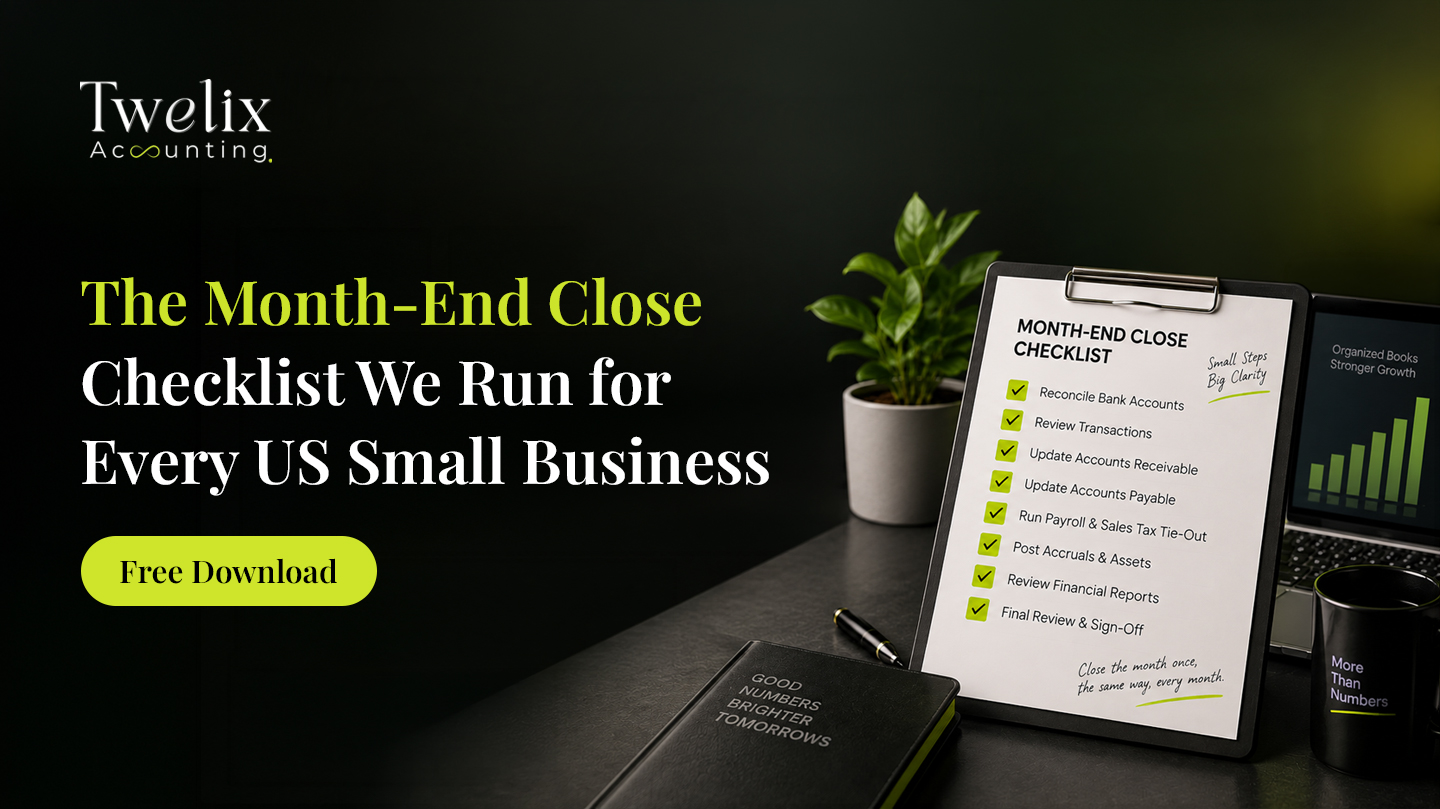
- The full month-end close checklist in running order
- What order do you close the books in, and why
- How long should a month-end close take?
- Your part of the close: the five things only the owner can do
- When the checklist stops working
- Download the checklist
- Close the month once, the same way, every month
- Frequently asked questions
It is the 3rd of the month. The bank balance is up, which feels like good news, and the one number you actually want, whether last month made money, is not anywhere you can look. The invoices went out. Most of them. The card statement is due in six days. Somewhere there is a folder of receipts from the trade show, and a payroll run that felt heavier than usual.
You will find out in April, when the return gets filed. That is nine months of decisions made on a feeling.
The fix is not more effort. It is a list, run in the same order every month, with each line assigned to the one person who can do it. Here is ours.
Quick answer
A month-end close checklist is the fixed list of steps that turns a month of transactions into statements you can trust: documents in, every account reconciled, receivables and payables settled, payroll and sales tax tied out, accruals and assets posted, then review and sign-off. Ours runs 20 lines across the first 10 days of the following month. Five of the lines are yours. Fifteen are ours.
What a month-end close checklist is (and what it is not)
#A month-end close checklist is the written list of every task that has to happen before a month's books are final, in the order they have to happen, with a name on each line. Some people call it a monthly bookkeeping checklist or an accounting close checklist. Same document. Its job is to make the close boring: the same steps, the same days, the same output, every month.
Three things it is not. It is not a general bookkeeping checklist of daily habits like "send invoices on time." It is not a cleanup checklist; if your books are months behind, you need a different list first, and there is a section on that below. And it is not a feature of your software. QuickBooks and Xero will run a profit and loss on an unreconciled month without a word of warning. The checklist is what stops you from believing it.
Every line on the list belongs to one of two people: the owner, who holds the source documents and the decisions, or the provider, who holds the ledger. We call this the owner-vs-provider split, and it is the reason most closes stall. A line sitting on the wrong side of the split, a statement the provider is waiting for or a bill the owner did not know needed approval, is where the days go. Get the split right and the calendar mostly takes care of itself.
The full month-end close checklist in running order
#Twenty lines, six phases, and a target day for each. The days are calendar days of the following month, because that is how deadlines actually arrive. Nothing here sits behind a form; the download at the end adds a tracker, not more steps.
| Step | What gets done | Who owns it | Target day |
|---|---|---|---|
| Phase 1: Documents in | |||
| 1. Bank, card, and loan statements | Every statement for the month, downloaded or forwarded. A bank feed is not a statement | You | Day 1 to 2 |
| 2. Bills and receipts | Vendor bills, receipts for anything not on a feed, and any new lease, loan, or contract signed in the month | You | Day 1 to 3 |
| 3. Sales data | Invoices issued, plus POS or platform payouts (Stripe, Shopify, Square) exported for the month | You, or Twelix where the platform is connected | Day 1 to 3 |
| 4. Payroll reports | Payroll journal and tax filings pulled from the payroll app for every pay date in the month | Twelix, with your confirmation that every pay date ran | Day 2 to 3 |
| Phase 2: Bank and card reconciliation | |||
| 5. Categorize the feed | Every bank and card transaction coded to the chart of accounts; anything unclear goes on a question list | Twelix | Day 3 to 4 |
| 6. Answer the question list | The 5 to 15 transactions only you can name, answered in one reply | You | Day 4 to 5 |
| 7. Reconcile every account | Each bank, card, loan, and payment-processor account tied to its statement; differences resolved, never forced | Twelix | Day 4 to 5 |
| 8. Clear deposits and transfers | Deposits matched to invoices, transfers matched on both sides, undeposited funds cleared | Twelix | Day 5 |
| Phase 3: Receivables and payables | |||
| 9. Invoices matched | Every payment received applied to its invoice; receivable aging reviewed for anything past 30 days | Twelix | Day 5 to 6 |
| 10. Bills entered and approved | Every vendor bill in the ledger; you approve what gets paid and when | Twelix enters, you approve | Day 6 to 7 |
| 11. Collections flagged | Overdue receivables listed with a suggested follow-up; you decide who gets the call | Twelix flags, you decide | Day 7 |
| Phase 4: Payroll and sales tax | |||
| 12. Payroll tied out | Payroll journal matched to the bank withdrawals; liabilities and benefits allocated to the right accounts | Twelix | Day 6 to 7 |
| 13. Sales tax reconciled | Sales tax collected compared to what was filed, by state; filing calendar checked for the month ahead | Twelix, with your confirmation of any new state | Day 7 to 8 |
| Phase 5: Accruals and fixed assets | |||
| 14. Accruals and prepaids | Expenses that belong to the month but arrive later booked; prepaid insurance and software spread across the months they cover | Twelix | Day 8 |
| 15. Fixed assets and loans | Purchases above your capitalization threshold booked as assets; depreciation posted; loan balances tied to lender statements with interest split from principal | Twelix | Day 8 to 9 |
| 16. Owner draws and contributions | Personal spending moved out of expenses; distributions and contributions recorded | Twelix flags, you confirm | Day 8 to 9 |
| Phase 6: Review and reporting | |||
| 17. Balance sheet review | Every balance sheet line tied to a statement or a schedule; no negative assets, no stale balances | Twelix | Day 9 |
| 18. Profit and loss review | The month compared with prior months; anything unusual explained, not just noted. A second person reviews before delivery | Twelix | Day 9 to 10 |
| 19. Close the period | Closing date set in the software; reconciliation reports saved | Twelix | Day 10 |
| 20. Package delivered and signed off | Profit and loss, balance sheet, cash flow, receivable and payable aging, and a summary of what changed. You read it and sign off | Twelix delivers, you sign off | Day 10 |
Read the owner column before anything else. Five lines carry your name outright, and four more need a reply or a sign-off from you. Everything else is the provider's, and none of it can start until the top of the list is done.
What order do you close the books in, and why
#The order is not a preference. It is a dependency chain, and every close that runs late broke it somewhere.
Documents come first because nothing downstream is trustworthy without them. A bank feed is a stream of transactions the bank chose to send. A statement is the bank's signed record of what happened. Reconciliation needs the statement.
Reconciliation comes second, ahead of anything that looks like a report, because it is the only step that proves the ledger matches reality. Until every account ties to its statement, the profit and loss is a draft. It may be a good draft. You will not know. In the contractor file we cleaned up this month, three years of profit and loss reports read $328,000 too high because nobody had run this step since 2023.
Receivables and payables come third, because open invoices and unentered bills move both the balance sheet and the month's expenses. Payroll and sales tax come next because they are liabilities with filing deadlines attached. Accruals and fixed assets come after all of that, because you cannot decide what belongs in the month until you know what is already in it. Review and reporting come last. A review of unreconciled numbers is a review of nothing.
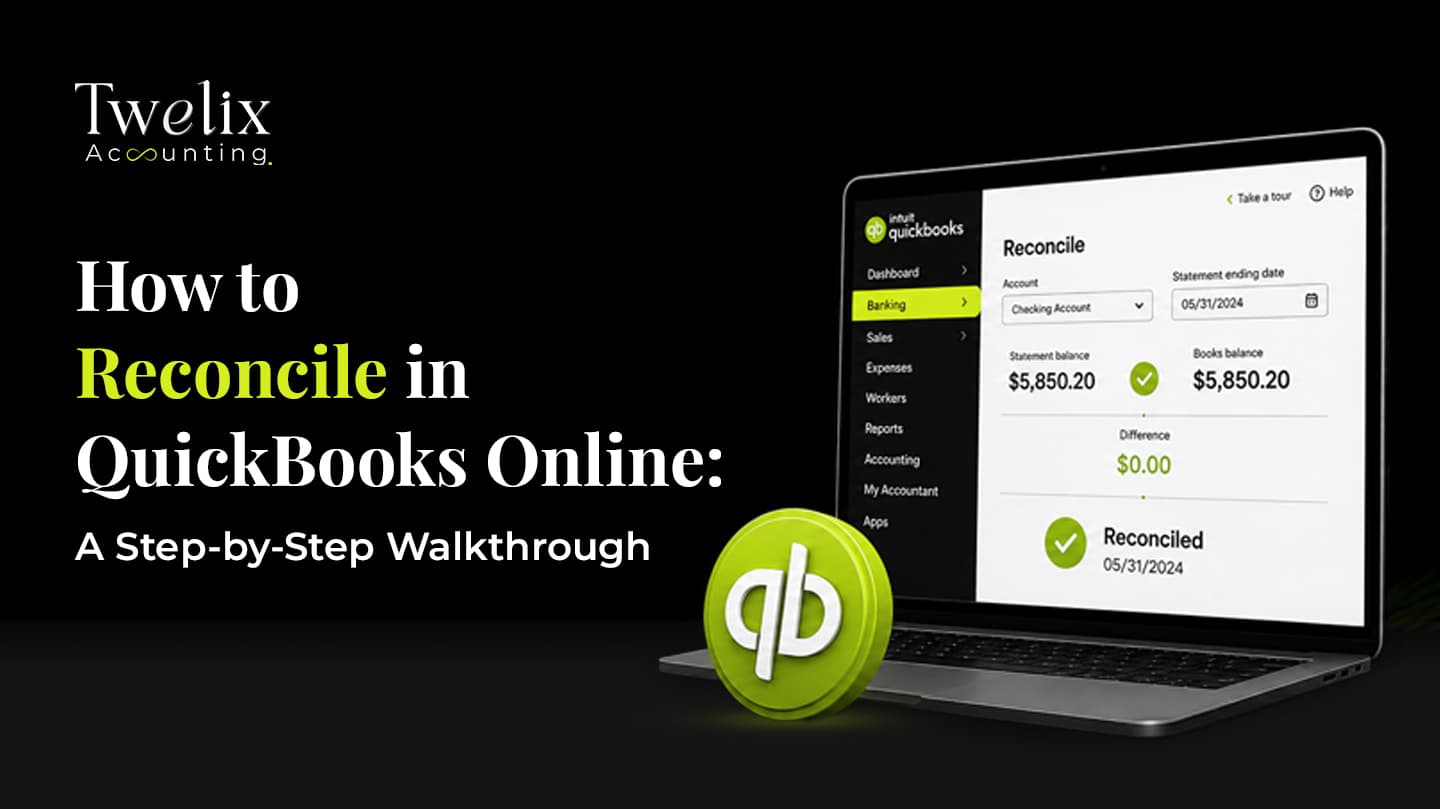
If you keep your own books in QuickBooks Online, the reconciliation step has its own walkthrough, including what to do when the Difference will not go to zero. We will not repeat the menu paths here.
How long should a month-end close take?
#An honest range. For a small, clean business with one or two bank accounts, payroll through an app, and no inventory, the close is an afternoon of work spread over the first week, and an organized owner can do it alone. Add a second entity, inventory, sales tax in several states, or a card that is not on the feed, and it becomes five to eight business days of provider time, with the owner's part spread across three or four short touches.
Our target is the 10th. Statements, package, sign-off, done, on the same date every month. That is a delivery promise, and it is only possible because the list above is fixed and the owner's five lines are short.
Here is the decision rule. If your close regularly finishes after the 10th, the problem is not the checklist and it is not effort. It is upstream: a statement that arrives late, a card that is not connected to the feed, an account nobody has reconciled since spring, or a bill approval that waits for Friday. Find the line that is always late and fix that one thing. The close shrinks on its own. If no single line is the cause and every month is late anyway, you are past a checklist problem and into a backlog, which has its own section below.
Your part of the close: the five things only the owner can do
#Being behind is normal. Most owners we meet are two or three months back, and it is almost never carelessness. It is that nobody told them how short their own list is. Here it is.
- Send the statements. Bank, card, loan, and payment-processor statements by the 2nd or 3rd. If your bank emails them, forward the email. If the feed is connected, the statement is still needed. The feed is not a statement.
- Approve the bills. A list of what is due and when reaches you around the 6th. You say pay, hold, or dispute. Ten minutes.
- Answer the categorization questions. Usually 5 to 15 transactions a month that only you can name: the online order that was tools rather than office supplies, the check to a name nobody recognizes. One reply, same day if you can.
- Confirm payroll and any people changes. Did every pay date run, did anyone start or leave, did anyone's pay change. One line back.
- Read the package and sign off. The profit and loss, balance sheet, cash flow, and aging arrive by the 10th. Read the summary, ask about anything that looks off, and sign. That sign-off is what closes the month.
That is the whole list. Forty-five minutes a month for most owners, most of it replying to questions. Our guide to outsourced bookkeeping covers what stays with you across the whole engagement. This is the monthly version.
When the checklist stops working
#Two situations break a close checklist, and each has its own list.
The first is backlog. If you are more than two or three months behind, running this checklist on last month produces statements that inherit every error from the months before it. Opening balances are wrong, so ending balances are wrong, and a clean close on top of a dirty ledger is decoration. The fix is a bookkeeping cleanup checklist first: reconcile every account back to the last clean month, fix what surfaces, rebuild the balance sheet, and only then start the monthly list. That is a project with a start and an end, typically 3 to 15 business days, and it is separate work from the monthly close.
The second is year-end. A year-end close checklist is this list plus a fixed set of extra lines: a physical inventory count if you hold stock, W-9s collected and 1099s prepared, fixed assets and depreciation trued up for the year, accruals reversed or carried forward, owner distributions and basis recorded, payroll tax filings tied to the W-2s, and a closing date locked for the whole year before the CPA package goes out. None of those lines are monthly, all of them are predictable, and a business that closes every month by the 10th does year-end in days rather than weeks. For the tax-side version, see what has to be closed before a business return can be filed.
Download the checklist
#The table above is the full month-end close checklist. Nothing was held back for the form.
What the download adds is the tracker: the same 20 lines on one tab per month, with the owner column, the target days, a status column, and a notes field, so you can see which line ran late and why.
Close the month once, the same way, every month
#The owner on the 3rd who does not know whether last month made money is not short on effort or software. They are short a fixed list with names on it and a date it has to be done by. Twenty lines, six phases, five of them theirs.
That list is how we close every client's books, in QuickBooks, Xero, or whatever file you already run, with each close checked by a second person before it reaches you on the 10th. If your close runs late every month, or has not run at all for a while, a free books review will tell you which line is the problem. See what the monthly service includes on our outsourced bookkeeping services page.
Frequently asked questions
What is a month-end close checklist?
A month-end close checklist is the written list of every task that has to happen before a month's books are final, in the order they happen, with an owner and a target day on each line. A complete one covers six phases: source documents collected, every bank and card account reconciled, receivables and payables settled, payroll and sales tax tied out, accruals and fixed assets posted, and a review before the statements go out. Its purpose is consistency, not cleverness. Run the same list on the same days every month and the profit and loss stops being a guess. It is different from a daily bookkeeping checklist, which covers habits like sending invoices, and from a cleanup checklist, which is for books that are already months behind.
How long should a month-end close take?
For a small, clean business with one or two bank accounts, payroll through an app, and no inventory, a month-end close is an afternoon of work spread across the first week of the following month. Add inventory, a second entity, sales tax in several states, or accounts that are not on a bank feed, and it becomes five to eight business days of provider time with three or four short touches from the owner. A reasonable target for a US small business is the 10th of the following month. If the close regularly runs past that, the cause is almost always upstream, a statement arriving late or an account that was never reconciled, rather than the checklist itself. Twelix delivers the monthly package by the 10th.
What order do you close the books in?
Close in dependency order: documents, reconciliation, receivables and payables, payroll and sales tax, accruals and fixed assets, then review and reporting. Documents come first because reconciliation needs statements, and a bank feed is not a statement. Reconciliation comes before any report because it is the only step that proves the ledger matches the bank; until every account ties out, the profit and loss is a draft. Receivables and payables come next because open invoices and unentered bills move both the balance sheet and expenses. Payroll and sales tax follow because they carry filing deadlines. Accruals and assets come last among the entries, because you cannot decide what belongs in the month until you know what is already in it. Review is the final step, never the first.
Do I need a chart of accounts before I can close the books?
Yes, and it does not need to be elaborate. A chart of accounts for a small business is the list of categories every transaction lands in: income lines that match how you sell, cost lines that match how you spend, and balance sheet accounts for cash, receivables, payables, loans, and equity. Most small businesses need 30 to 60 accounts, built around the decisions you make rather than the layout of a tax form. Without one, categorization becomes guesswork, reports change shape from month to month, and the close never quite finishes. If your chart has grown into hundreds of near-duplicate accounts, fix that before the next close, not after. Twelix reviews and tidies the chart of accounts during onboarding, before the first close runs.
What is the difference between a month-end close and a year-end close?
A month-end close finalizes one month: accounts reconciled, entries posted, statements produced, and the period locked. A year-end close is that same checklist run for December plus a fixed set of annual lines: a physical inventory count if you hold stock, W-9s and 1099s, fixed assets and depreciation trued up for the year, accruals reversed or carried forward, owner distributions and basis recorded, payroll filings tied to W-2s, and a closing date locked for the whole year before the CPA package goes out. The year-end close also feeds the tax return, so its output is reviewed by your tax preparer rather than just by you. A business that closes every month by the 10th does its year-end in days. One that does not spends January rebuilding the year.

CA Jaimin M.
Founder & CEO, Twelix Accounting
Published
Jaimin M. is the founder and CEO of Twelix Accounting, where he leads strategy and overall direction. A Chartered Accountant with more than eight years in U.S. accounting, he shapes how Twelix delivers outsourced bookkeeping and accounting services to small businesses. When he is not running the company, he is deep in a game, insisting it is helping his strategy skills.
Connect on LinkedIn